If you haven’t heard, there are some sizeable fires right now in the Northwest Territories. These fires haven’t really had any northerly winds. Until tonight.
As a strong low moves east over the Northwest Territories this evening it will, of course start sending some of the smoke down in the direction of us. In Alberta for tonight and tomorrow, most forecasts think we’ll have westerly winds. However, there is a chance that a trough is created going south of the low, meaning MAYBE the winds could be more northerly. If this is the case, then the smoke might actually reach us.
If you’re wondering what the forecasts say, then:
Environment Canada: Nope.
AQICN: Nope.
Accuweather: A bit might get us, but not too much.
Going way back all the way to about a year ago, it first started to seem likely that a low to moderate El Niño was in store for the 2025/26 winter. However, back then I was still watching the 2024/25 winter to see what it would end up being (which was a borderline La Niña). After that, it was looking like a likely weak El Niño for this upcoming winter. Only around February did it actually show some sign of a reversal of the trend on the forecast. During February and March, about 25% of models were saying the Niño3.4 area (the section of the Pacific Ocean that is measured to deduce ENSO*) was going to warm up in the spring, peak a little above average in July or August, and then fall back down to a weak La Niña. This was interesting at the time, but it still looked unlikely to happen. Over the next few months, more and more models switched from above average to below average on the forecast, which leaves us at now, where only about 15% of the models still say we will have an above average anomaly this winter (but 0% say we ill get actually close of an official El Niño).
So Ben, what does that even mean and how much snowfall will we get from Sep 13, 2025 at 7:48 am to April 4, 2028 at a pi/3 seconds after 1:12 pm to the nearest hundredth of a centimetre? – Someone who doesn’t know that inaccuracies exist, July 2025
I’m just going to ignore that question. Next!
Ben, how will this affect the temperature and snowfall this next winter? – An actually sensible individual, also July 2025
Much better. As it stands, expect something similar to last winter; moderate not-very-infrequent cold waves, near to slightly above average snowfall. That’s about as much detail as I can do right now.
*If you didn’t know, ENSO stands for El Niño Southern Oscillation.
For this week; hot Tuesday, cool Wednesday and Thursday, warm again Friday. Next week we should see some rain to start and rain to end, with a very short-lived heat wave in the middle. After that, we enter a large region of uncertainty. This last a few weeks, and is basically just an period where no forecasts really agree on what will happen.
August
Can’t go into too much detail, but basically warm in the first half and cool in the second half. Probably. Also, likely there will be more precipitation than July.
Today the temperature has reached a high of 25, which is above seasonal, but not by much. However, tomorrow the temperature is forecast to reach 27-33, most likely 30 or 31.
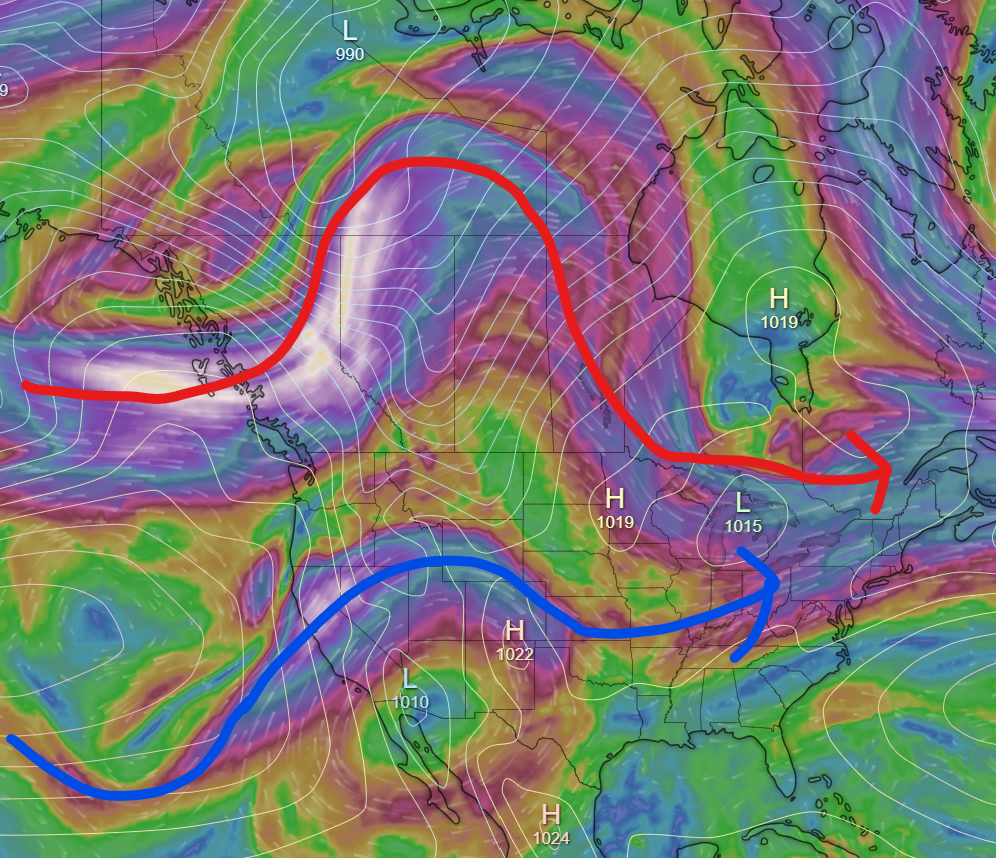
The reason for this? Well, if you look at the map below, you can see what’s going on. There is a low in northern Mexico that is expected to push the subtropical jet stream (blue) northward, which in turn sparks a ridge in the main jet stream (red). An upper-level low in northern BC will then fuel this spark and create a upper-level ridge over Alberta and Saskatchewan.
(By the way, this map is for Tuesday night, about midnight.)
July 8th has one of the lowest heat records for July, meaning that we will be getting pretty close to it. I would say it is relatively unlikely that we beat 32.6 degrees, but it is still a possibility.
After tomorrow night, the temperature will take quite a plunge, with a high a few degrees below seasonal set for Wednesday.
Over the next 7 days, many showers and storms are set to pass through, and it looks like it will total all the way up to 50 mm of precipitation. For reference, that about as much as we got in all of September, October, and November combined.
So, how is this expected to play out? Well:
MONDAY
We will start off with today. During the actual day, nothing has really fallen, but tonight we might see some action. Overnight, it seems like a thunderstorm will pass through, bringing a widespread 1 mm, but much higher amounts, like 10 mm, in certain places. For our 50 mm, I am just using the widespread amount, which means if you (or rather your plants) are lucky, you may even see well over double that amount.
TUESDAY
For all of the day and night tomorrow, there is a chance of showers or thunderstorms. We are most likely to get some in the evening. A few widespread millimetres, but of course higher amounts where the strong cells hit.
WEDNESDAY
On Wednesday, thundershowers could show up anytime from sunrise to sunset, with showers possibly prevailing through the night. Here the areas that storms have missed so far look like they’ll get a treatment of 5-10 mm.
THURSDAY
Thursday looks like quite a bit of rain and maybe thunderstorms as well during the day, and some lingering showers into the night. Overall 10-15 mm of rain. That’s quite a lot!
FRIDAY
On Friday, MORE thundershowers in the day, and steadier rain in the night, totalling 5-10 mm of rain.
SATURDAY
Showers throughout the day and night, but finally a break from thunderstorms. Another 10-15 mm.
SUNDAY
Though not in this week, Sunday is expected to be sort of a continuation of Saturday, with an extra 5 mm.
So overall, we are supposed to get pretty much non-stop periods of rain, showers, thundershowers, and thunderstorms for the next 7 days, totalling to 50 mm. Now that’s a lot of rain.
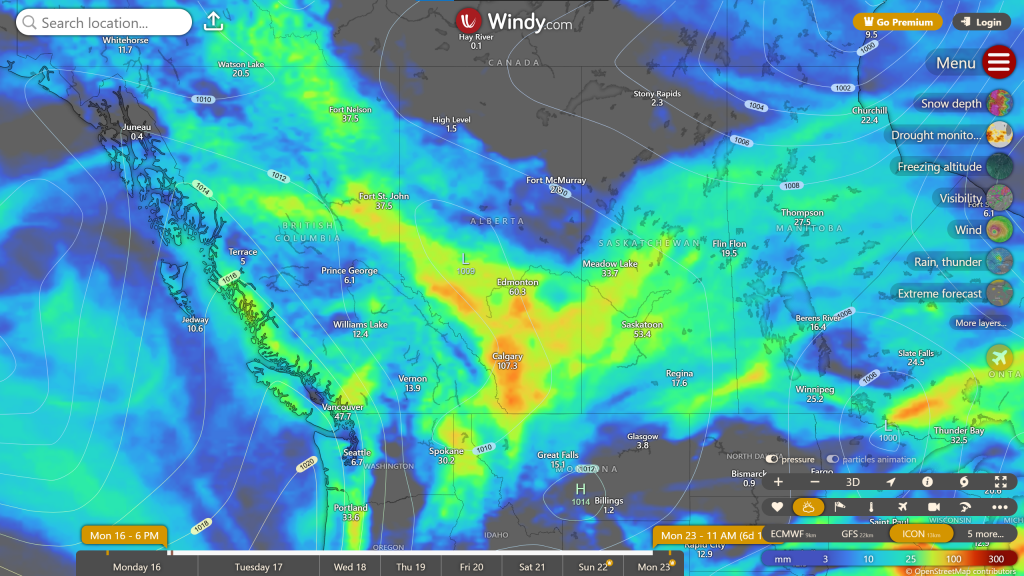
Also, here’s the expected total rainfall for the next 7 days on a map:
You can see that this is not just local. Lots of Alberta and Saskatchewan are getting similar things to us.
You might have seen on the forecast that today and tomorrow will be quite chilly and rainy, but that may change for the rest of the week.
Today we got a pretty easy-to-understand upper atmosphere layout. All you really need to know is that currently there is a low off the west coast, far enough south that I wouldn’t consider it in the Gulf of Alaska; and a high over the tip of Québec. For this, we’ll say that the low is stationary, even though it isn’t. Because that will make this simpler. So, for this pattern, a really crazy rare thing is happening to the high: It is moving west! Isn’t that crazy? Right? Right?
At this point some of you may already be confused. But don’t worry. I’ll explain. Basically, all systems on Earth like to move east. They like doing it more than anything else. So, they will almost never go west unless if the right pressure systems manage to push it that way. For a more correct explanation, head down to the bottom of the page.
Moving west, eh? Lets see what’s west of Québec. Since upper-level ridges usually come up west of highs, lets go 2500 km. Wait a minute…
Wait a minute indeed. As well, remember that low? Well, what if I told you that at the same time as that high will move west, another low will appear in the central to western US and then we suddenly see an upper level alternation: Low-high-low. You know what that means? It’s omega block time!!!1!11!
If you don’t know what an omega block is, then…sorry. I don’t have enough time to explain that all. I already made a huge hunk of a paragraph at the end of this post. Maybe just use google for this one.
Okay Ben, just tell me the forecast already! All this buildup wasn’t in the job description!
Okay, here’s actually why systems move east: Despite what flat earthers tell you, the Earth IS a sphere. In addition, it is spinning. This spinning interacts with the upper troposphere (It does affect more, but that doesn’t really matter for weather) and creates streams of very fast-moving air. These are the jet streams. The jet stream interacts pressure systems, witch in turn interact with others, and eventually almost all the systems move west. Of course, in the southern hemisphere it is flipped, and as well some systems can actually move the “wrong way” on their own when they’re near the equator. This usually happens with tropical cyclones, which is why some Maritimers may keep an eye out when the Caribbean is warm and a cyclone develops off the west coast of Africa.
You may have seem it already on Environment Canada; those temperatures will be warming quite a bit!
Coming up late this week, on the weekend, and also for a big chunk of next week temperatures are expected to be slightly to far above average. Currently, Environment Canada is forecasting a highest temperature for the heat wave of 17 degrees, AccuWeather is saying 16, and The Weather Network 13. I would say we’re probably going to get to somewhere between 15 and 20 degrees. For more details, you can check Element in a little while; I’m going to post a chart there soon.
There is something special about this heat wave – It’s actually our first “summer” heat wave. What’s a “summer” heat wave? Well, here’s an explanation:
In winter, heat waves are almost always caused by low pressure systems. Meanwhile, cold waves are created by high pressure systems. In summer it’s the opposite; heat is caused by a high, and cold is caused by a low. In spring and fall, it can be either, but usually the former half will have a similar pattern to the preceding season, and the latter half will have a similar pattern to the proceeding season.
So far, this spring we have not had any summer-like patterns, but this upcoming heat wave is going to change that, making it so that we will have had one yet. That’s a lot of one-syllable words in a row!
“But Ben, what’s causing this? Like really, what IS causing this?!” -You; March 2025
Currently, we have a rex block (a high north of a low that stretches the jet stream into a backward S shape) in the Pacific. The high is over the Aleutian islands, and the low is around the very outmost Hawai’ian Islands. As we look into the next 24 hours, we actually see the high fizzle out right away. Usually this would mean the upper-level ridge just fades to nothing. However the low has different plans. It harnesses the jet stream over Tuesday night before then actually reinforcing the upper-level ridge. As this point there is also high pressure off the west coast of the US, and a low in the southern US. This is starting to look like an omega block!
As the jet stream violently squeezes the off-the-west-coast high, a new one enters the scene. A new high that very quickly formed and strengthened over Yukon and the Northwest Territories is beginning to race down to the Canadian and even American prairies, and is pushing down the cold air, leaving average in its wake. This average is what we’re going to feel on Friday. Then, the low follows behind. However, the low is actually still in the Gulf of Alaska. What has happened is the low has created a very long trough which wraps all the way around the mountains, and down into Alberta, as it follows the high. The trough reaches Alberta on Saturday, and then we delve into the realm of above average temperatures.
How long will it last? Well, it seems maybe around next Tuesday a low will break up the omega block, so we might return to average around then. This is not completely guaranteed, but later next week the low might restrengthen and might seed another omega block and another high might reinforce that, but I’m really unsure.
For about the third time this month, this will probably be the last significant snowfall event this season.
Starting tomorrow, a low will slowly track across the prairies, bringing an extensive clouds bank set to bring swaths of snow. Here is a table of the different forecasts and what they think:
Environment Canada
Accuweather
The Weather Network
Wed morning
No precipitation
No precipitation
No precipitation
Wed afternoon
Periods of rain
No precipitation
Couple of showers; <1 mm
Wed evening
Steady rain and snow
Periods of rain; ~1 mm
Steady rain and snow; <1 mm, <1 cm
Wed overnight
Steady rain and snow
Steady rain and snow; 1-3 mm, 1-3 cm
Steady snow; 1-3 cm
Thu morning
Steady snow
Periods of snow; 1-3 cm
Steady snow; 1-3 cm
Thu afternoon
Steady snow
Periods of snow; 1-3 cm
Steady snow; 2-4 cm
Thu evening
Steady snow
Steady snow; 5-10 cm
Steady snow; ~5 cm
Thu overnight
Steady snow
Steady snow; 5-10 cm
Light snow; 1-3 cm
Fri morning
Couple of flurries
Periods of snow; ~1 cm
Couple of flurries; ~1 cm
Fri afternoon
Couple of flurries
Periods of snow; ~1 cm
No precipitation
Fri evening
No precipitation
Periods of snow; <1 cm
No precipitation
Fri overnight
No precipitation
Periods of snow; <1 cm
No precipitation
Overall, I’d say we’re probably going to get about 15 cm, not without a chance of it being as high as 25. Environment Canada says 15-25 cm, Accuweather says 20-30, and The Weather Network ways ~15.
A really big weather flip is on it’s way, which will set the weather tone for the rest of spring break. Here’s what’s going on:
If you have taken a look at a forecast lately, you probably would have noticed the temperatures are about to drop way down to near 0 highs. Well, what’s the reason for this? Mainly, it is three pressure systems tangling the jet stream in just the right way for an extended cold wave. Here’s a picture to explain what’s going on:
The map here shows what the wind is like right now 9 km above us. The yellow line shows where the jet stream is right now.
I have on the map our three pressure systems marked out. There is a low in the Gulf of Alaska (Red), a high to the west of that low (Orange), and a high near the north pole (Yellow). The high in the Pacific Ocean will move northward (Lime), and push up the jet stream (Green). The big thing that will cause the cooldown is the second high, which is in the polar vortex, moving down towards the land (Blue). It is moving because it was pushed away by the first high moving northward and causing the jet stream to ridge. As this high moves down, it will push the jet stream south creating an area of zonal flow (Light blue), which doesn’t really matter to us as it’s in the southern US. However, what does matter is that the high has moved down south to the Canadian prairies, and will be giving our area a period of cool weather (Dark blue).
Well, looks like we’ll be in for a ride with all the water freezing up again. Luckily, it doesn’t look like we’ll get any precipiiwwait a minute! You thought it was over? Try reading the next post! This one was only part 1!
This March, big temperature inversions will continue. Of course. Here’s an overview of what we may see:
First of all ,a big heat wave for about the first 1.5 weeks. This is the one we’re in now. Coming up, at about the 9th we’ll see some snow and temperatures dropping to near average, and then around the 13th some more snow and temperatures dropping to below average. Currently, it’s looking like these temperatures will continue until near the middle of the month.
After that, it looks like we will warm up, but I’m not sure how much or for how long. Eventually though near the end of the month, we will cool down again, and we’ll probably see our last significant snowfall of the season then.
Overall, we’ll probably see a mainly near- to above-average temperature anomaly this month, and likely below normal but not far below normal precipitation.