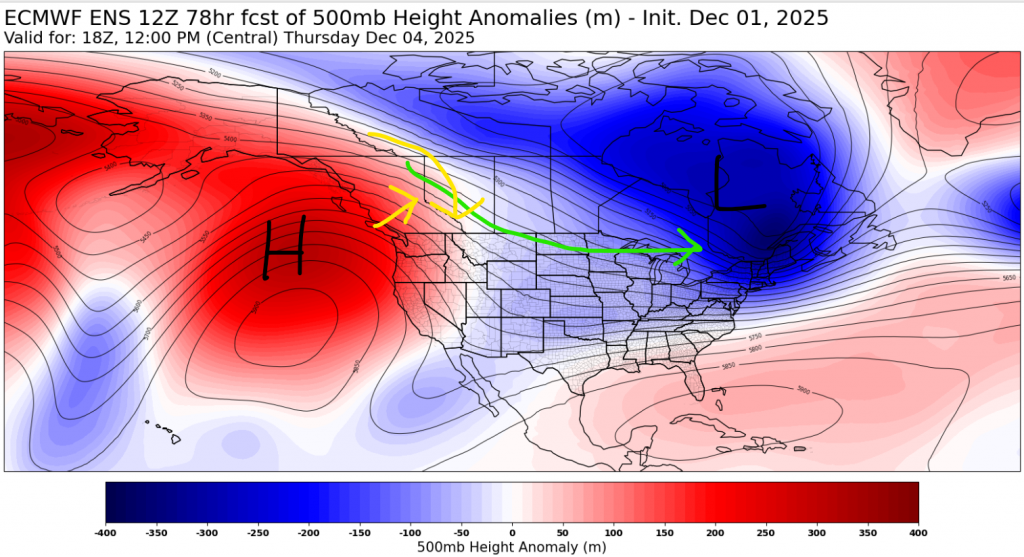
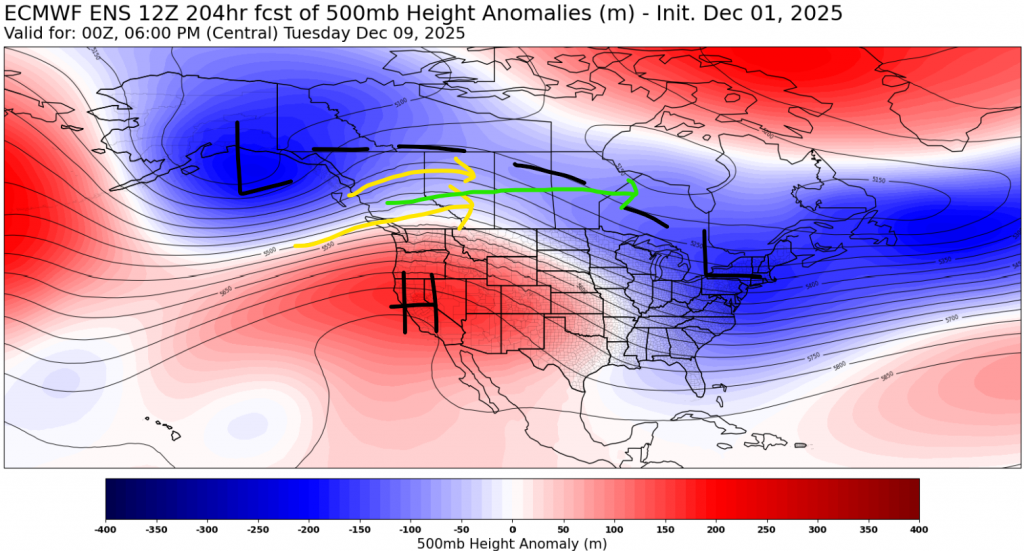
The snow was falling 4 centimetres strong only a mere 2 days ago, and now we are already talking about 20 degrees. The continental climate strikes again!
Over the next few days, it seems the pattern is simple: Every day is warmer than the last. Today is somewhere around 10 for a high, a little warmer tomorrow, 15-18 degree range for Sunday and Monday, and then likely reaching 20 on Tuesday. Lows are much the same; slowly rising from a few degrees below 0 tonight to around 5 Tuesday night.
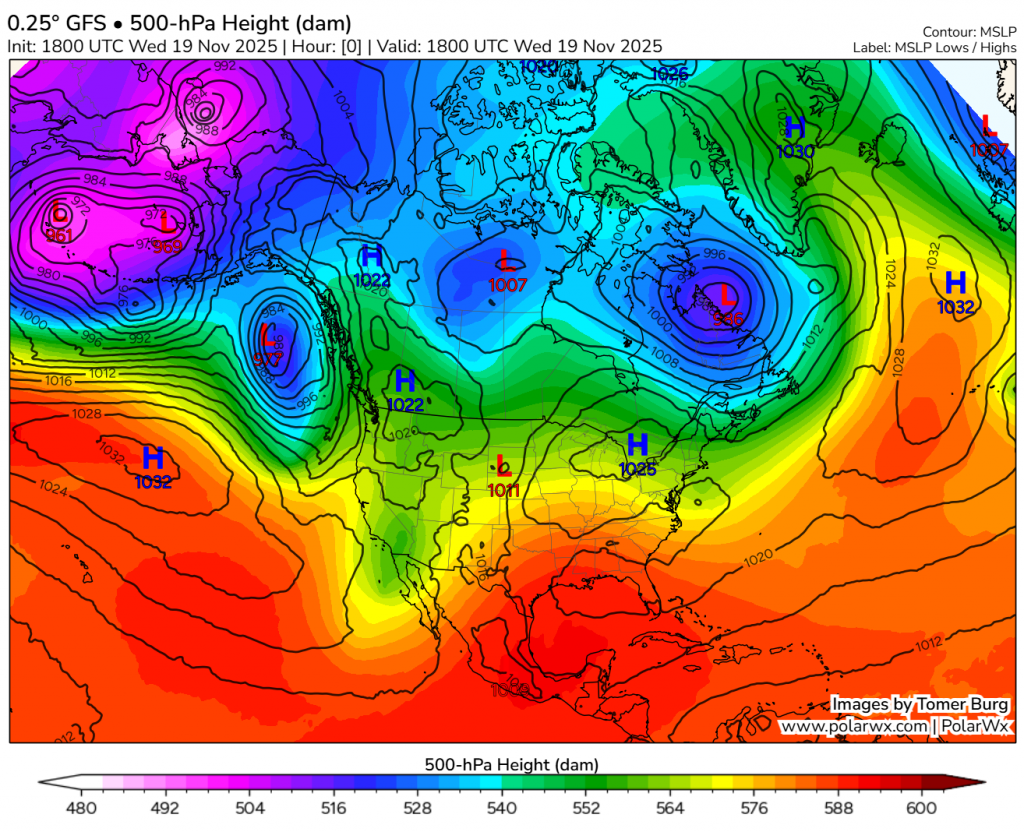
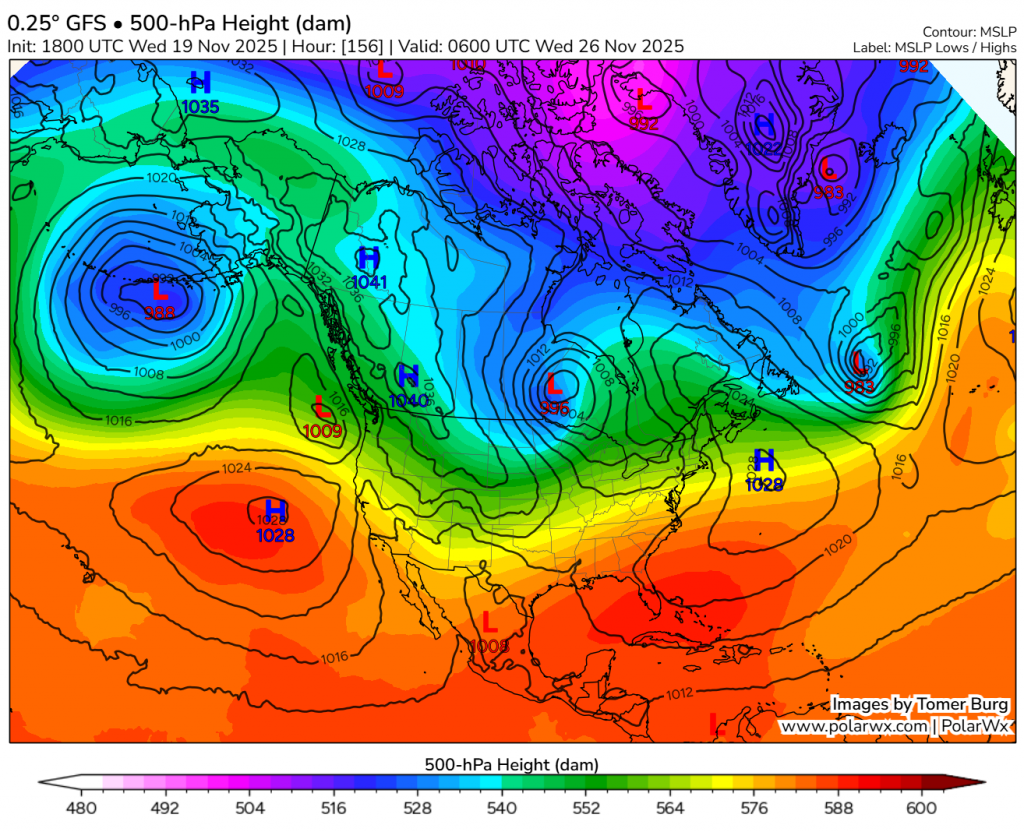
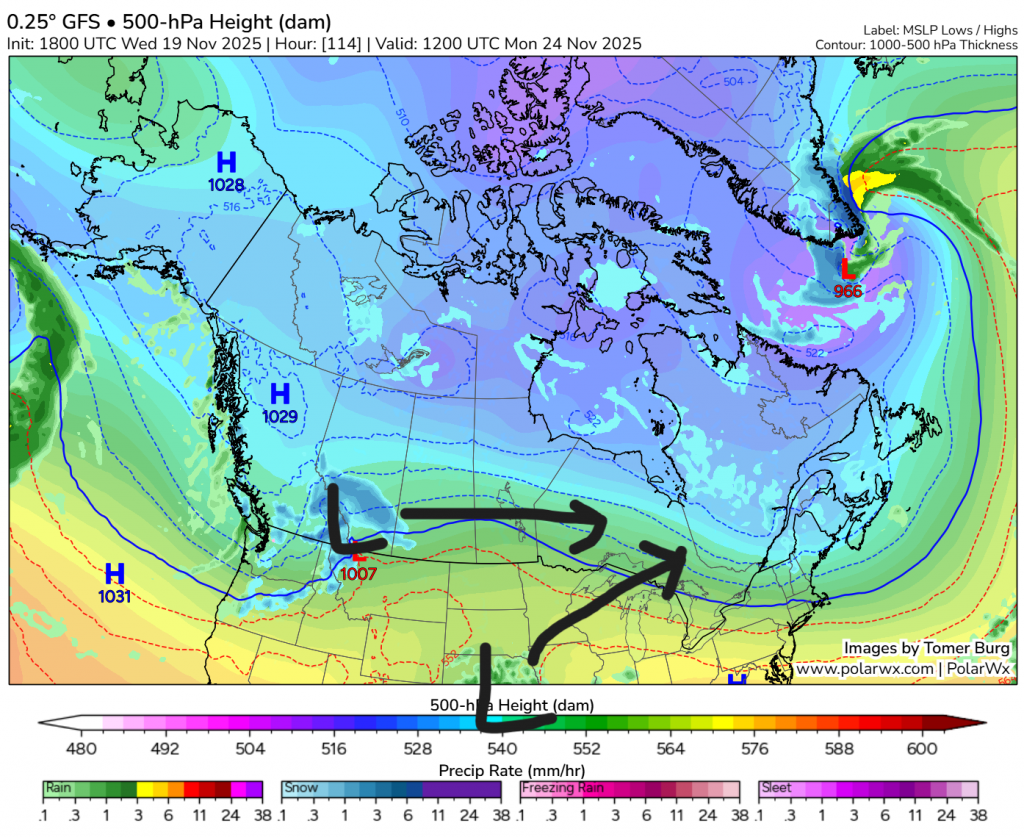
Now what is causing this? Pretty simple. Right now a lot of chilly air is present over Canada, specifically western areas. All of this air is expected to move over to eastern Canada over the next two days, then open up western Canada for ridging, and put a cut-off low just off the west coast. The jet stream will be in a straight line from Whitehorse to northern Ontario, and some lows will be riding over it. The first low will pass through on Sunday and not really affect us at all, while to second one will grab on to the cut-off low, and will slowly bring it east and gives us some more unpredictable weather mid-week.
Lows have counter-clockwise winds going around them, so to start these lows to the west will give us southerly winds, and give the already warm temperatures an extra boost on Tuesday. As these lows pass over though, the temperature will likely quickly drop, and it might give us some thunderstorms too. So because of these lows, we might quickly go back to cold after this heat wave.
That is all there is to say, so thanks for reading!
For the millionth time over the last month and a half, another system is bringing a little douce of snow.
Currently over Canada the main idea is a big trough in the east and ridging in the west. It is a more extreme west for the ridge, so northwest flow + cloudy skies = still below normal temperatures for us today. A little low is trying to sneak in from the west, and is currently in the Gulf of Alaska. It’s around the coast right now, and it will spill across the Rockies this afternoon and evening, generating an Alberta clipper. Snow is currently spreading eastwards over northern Alberta in advance of this, and according to the radar, it is around Slave Lake right now.
Over tonight the clipper will move southeast, then stabilize to a zonal track in the southern prairies. The precipitation for this system is quite complicated, and also very inconsistent between models. The main idea is that a front will come around behind the low with some snow there, and a big swath will set up something around 200 km north of us. If this holds true, we might see a short but moderately heavy bit of snow (or maybe rain I guess?) sometime early to mid overnight, then a break in precipitation until tomorrow afternoon, or maybe the evening, when the swath comes down, and gives us some intensity of snow, depending on how much moisture is left. As you can see, the models don’t really know what they’re doing.
So how much snow for all this? I don’t really know, but we’ll say 1-5 cm, really depending on that swath. One more thing to note; in the wake of the cold front we will probably see some strong winds maybe something like 30 gusting to 50.
Yay, another post! This one is for quite a significant event incoming; the return of winter. For the last several weeks, warmth has dominated. It was quite a change after all the chaos that ravaged us in December, but now it seems we might be returning to that.
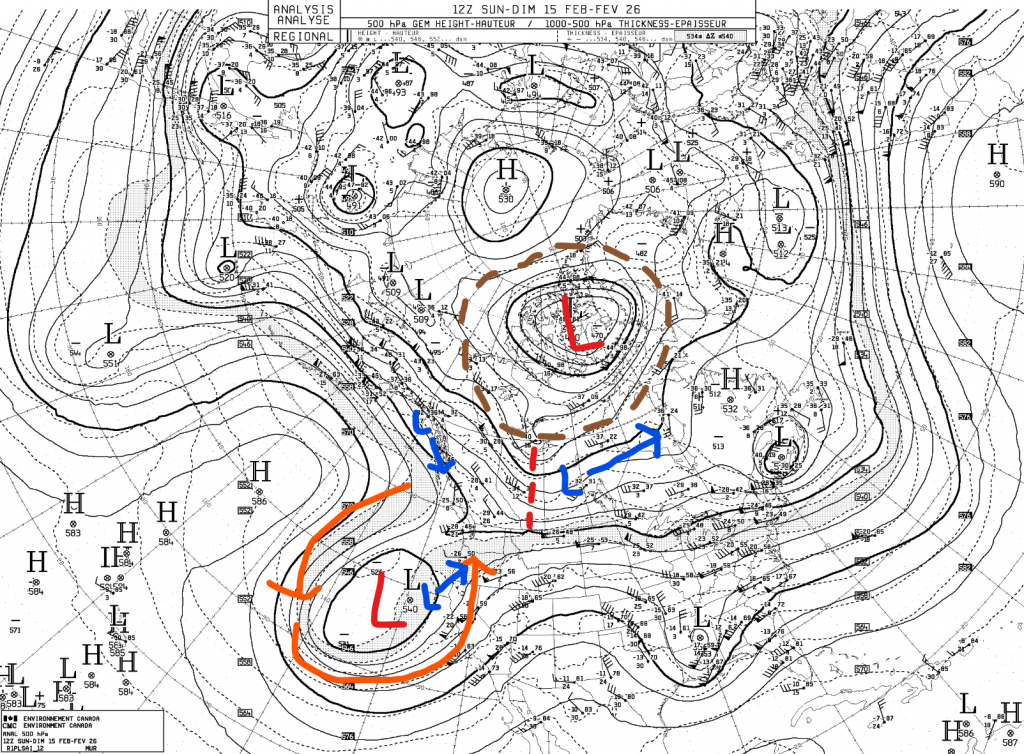
Before I get into the timing of the precipitation, here’s a 500 hPa map for right now:
I have two major upper lows (red) marked in this picture; one in the Arctic and one in the Pacific. The Arctic one is currently the most dominant polar vortex lobe on Earth right now, and has been bringing some absurd stuff like below -60 wind chills to some communities. That was not a typo. It has a bit of a trough, which has been the source of our slightly cooler temperatures yesterday and today, but the main product of this trough has been some light snows in SK/MB. Those are associated with a surface low (which I have marked in blue) currently moving quite quickly to the east.
The other major upper low is a cut-off low off the Californian coast. Flow around it is marked in orange. The last two lows on this picture are other surface lows, which are moving in the direction of their arrows, but not very fast.
If you haven’t read the previous post yet, I would much suggest doing that now. You can see the pattern change that I described there getting ready to occur in this image; the big upper high there in the Pacific has a ridge going upwards, with some lows to the left. Those very lows, specifically the more southern one, are the ones that will push the ridge way up to Alaska, causing the reflection over the west coast of North America.
The low in blue currently on the southern Alaskan coast will be the one attached to the soon-to-descend upper low. As this low moves south, the upper-level flow will merge with the cut-off low, while the southbound surface low will instead push the existing one already there off to the northwest. Know what else is to the northwest? Us.
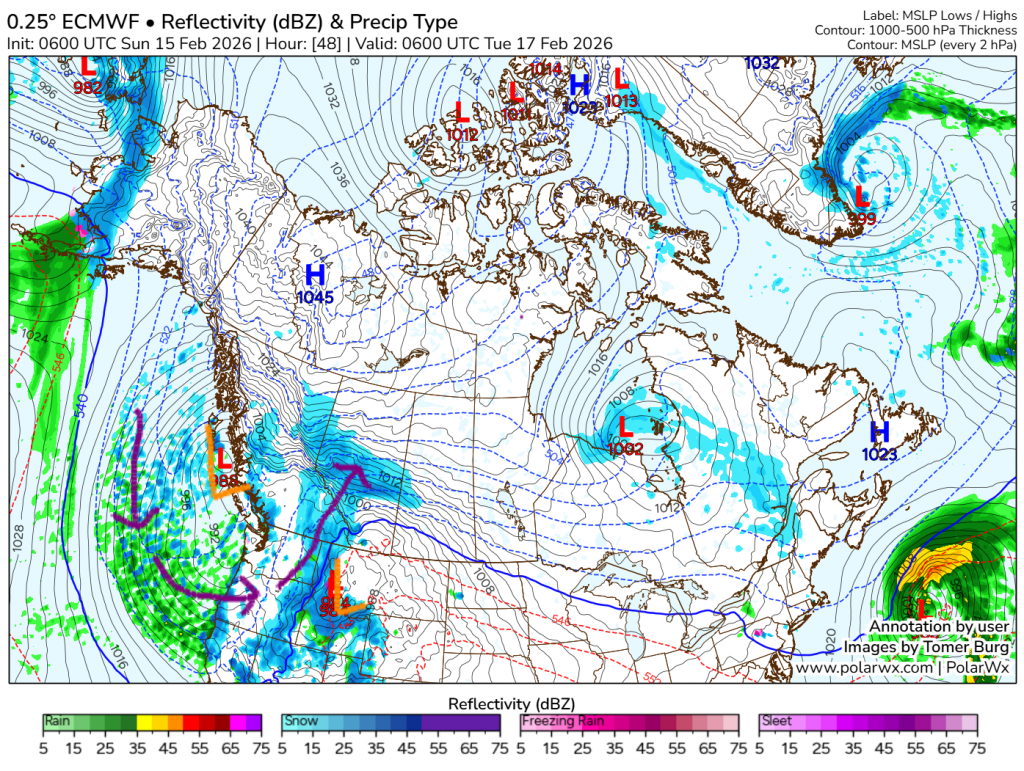
Now that you know the setup, let’s play out what will happen:
The first image shows midnight on Monday night. The low on the coast is descending, while the one that was way down south is now all the way at Montana. With these two systems so close, which one’s wind field will dominate? The answer is the one on the coast for near the surface, because it doesn’t have as many mountains in the way of it. Once you get above the mountains though the separation will roughly get to the middle. This means three key things: One, the cloud will be carried way up from the Pacific, meaning it has a lot of moisture, so the cold air will cause a lot of condensation and then precipitation; two, there will be a lot of wind shear increasing instability and thus further increasing precipitation intensity; and three, the cloud, though still attached mainly to the Montana low, will be pushed northward by the other low, meaning precipitation will later be as far as over 1000 km north of the actual low, meaning the low is in the US while precipitation is touching the NWT.
As you can see in the first image, snow as already started for us. It will probably begin sometime in the afternoon tomorrow, most likely later in that time frame, before quickly intensifying.
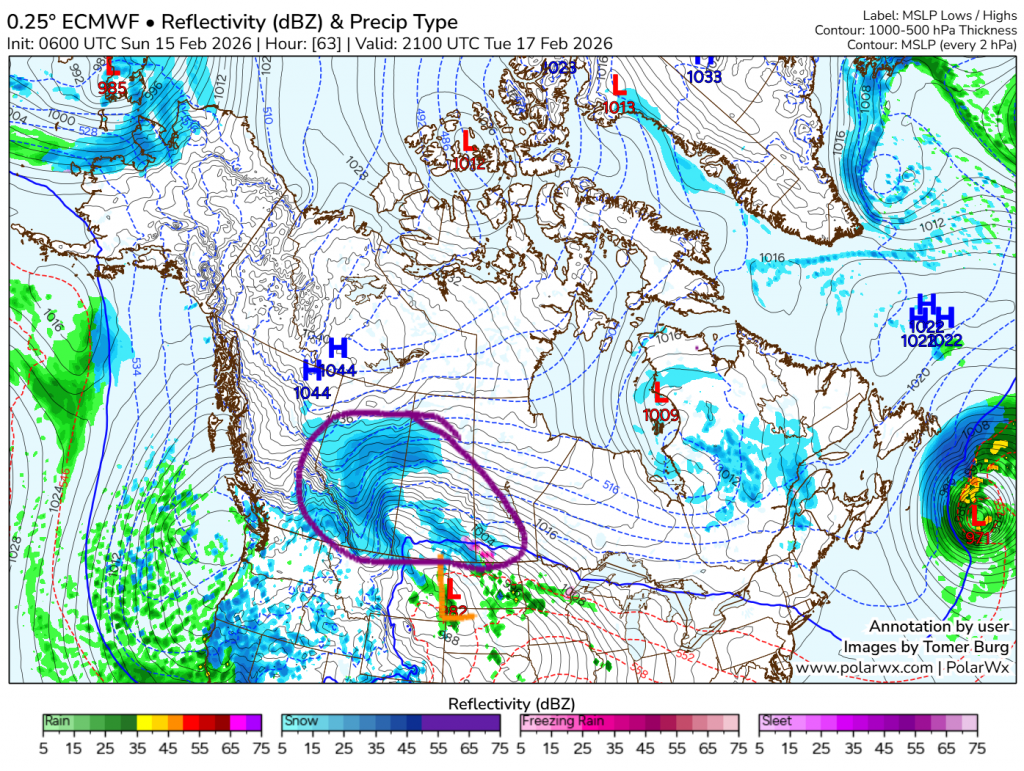
The next image skips ahead all the way to mid-afternoon on Tuesday. The low barely moved, while the snow now engulfs most of Alberta and areas of Saskatchewan. Heavy snow has not really stopped at all for nearly 24 hours.
The third and final image is another 24 hours after the second. By this point snow has stopped, but it doesn’t really seem like it has for very long.
So now, what are our accumulations? For the southern three quarters of the province, most forecasts are somewhere in the 10-20 cm range. There is the possibility of local accumulations getting up to 30 cm basically anywhere in this area, depending on what model you decide to look at. There is also a risk of blowing snow for Alberta, though mainly south and east of here. There might be some mild blowing snow for us, but mainly it will just be pretty drifty, and definitely not a blizzard.
What about temperatures? It seems they will be declining at some rate from Tuesday afternoon to Wednesday morning. Tomorrow will have a high somewhere around -5, and -20 is likely to be reached on Wednesday. I will have out a more detained post on the temperature in a few days’ time.
So there you have it. This snow is probably going to be very disruptive, so be prepared for some travelling troubles on Tuesday and Wednesday, before the snow starts to get cleared. Goodbye, and happy shovelling!
Hello everyone! It’s been quite a while since I’ve posted on here. Not very much is happening right now in the short range, but just beyond that, oh boy do we have something coming.
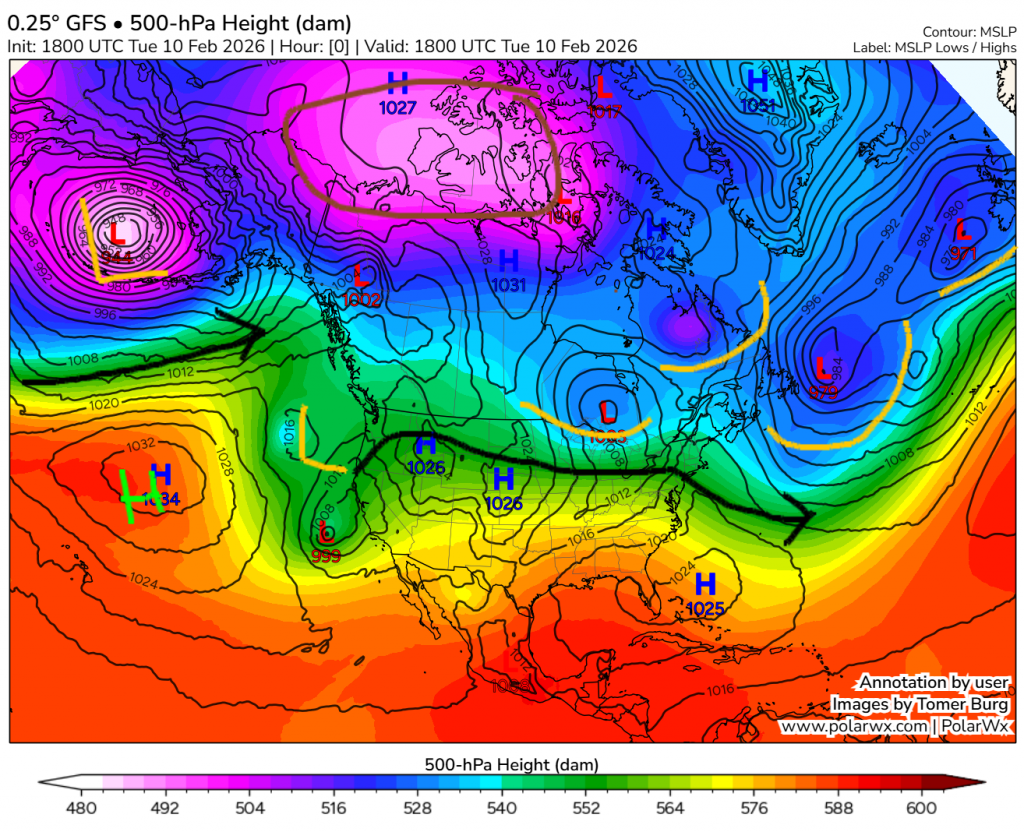
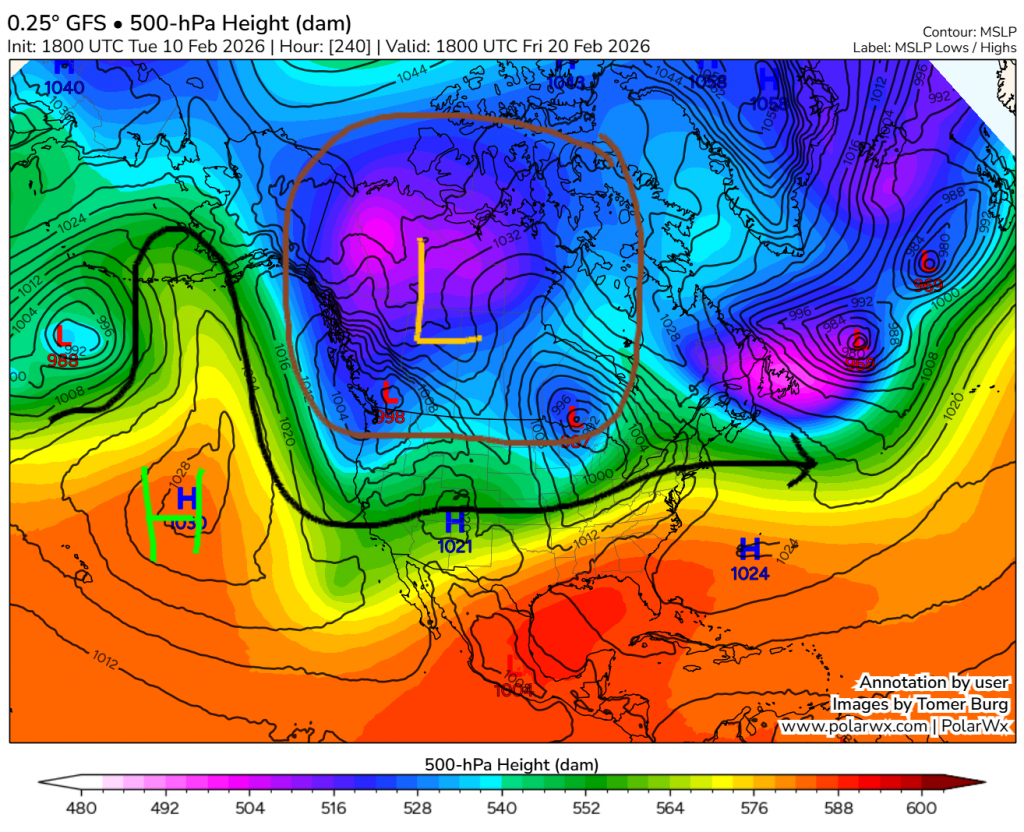
Let’s start with the GFS model, showing 500 hPa geopotential height (for the people who don’t know what that is, just the altitude the pressure reaches about half of that of the surface), and air pressure at the surface.
For some reason, WordPress decided that that last image had to be really big.
Let’s start with the first image, which shows conditions right now. Flow is screaming through the Pacific, as it is being tightly squeezed through a deep high and deep low. A lower-pressure area is present off the west coast of BC/US, and moderately strong mostly zonal flow resides over the majority of Canada and the US. The polar vortex is centred over the Arctic, as shown in brown; and across the Atlantic troughing is prominent.
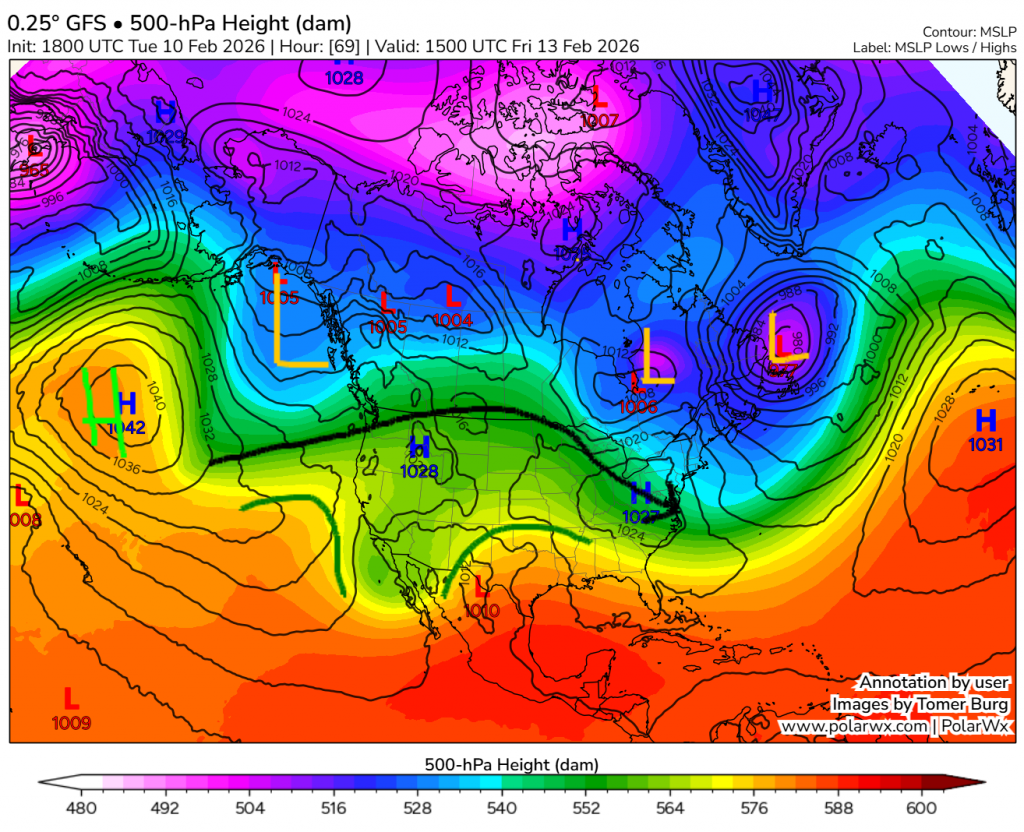
The second image shows forecasted conditions for Friday. In the Pacific a large ridge has built (which will get our PNA quite negative), and over North America ridging dominates in continental regions, while the coasts have troughing.
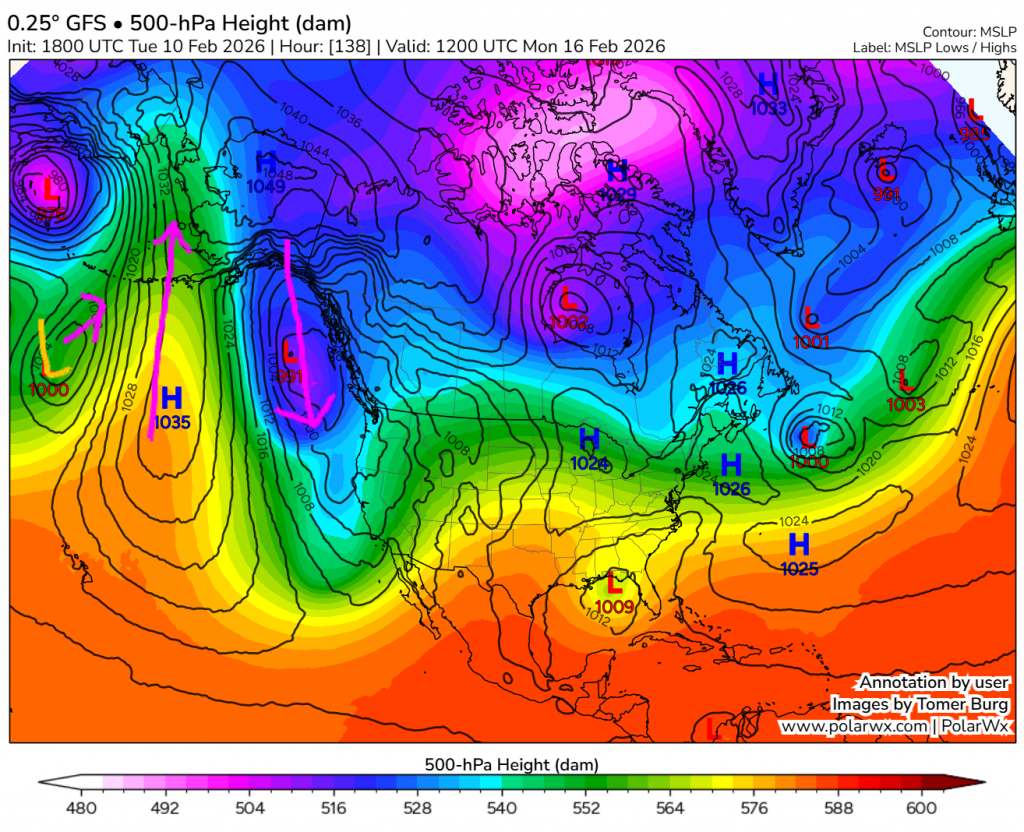
On the third image, we see over the weekend a low will intrude on the big Pacific high, pushing a lobe far northward. Because suddenly a bunch of warm air is all the way up there, the polar vortex must adjust and send a bunch of the cold air down just after.
That will sure mess up things far a few days, so the final image is for 4 days later. The Pacific high is still present, and a large polar vortex lobe is now over western and northern Canada.
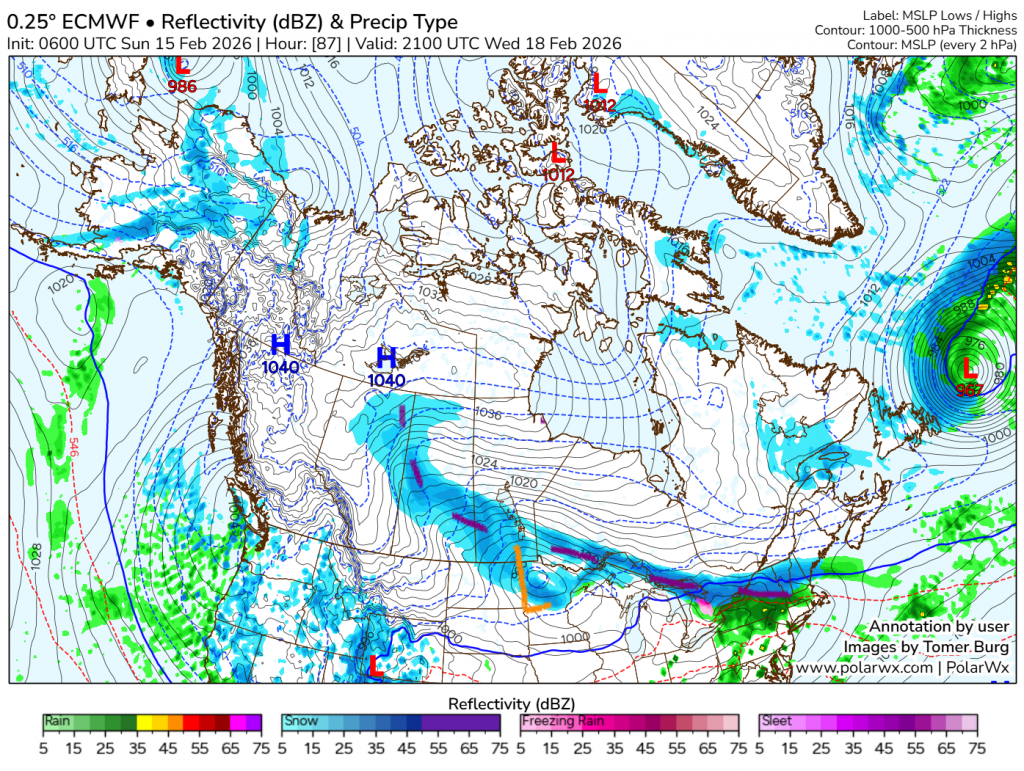
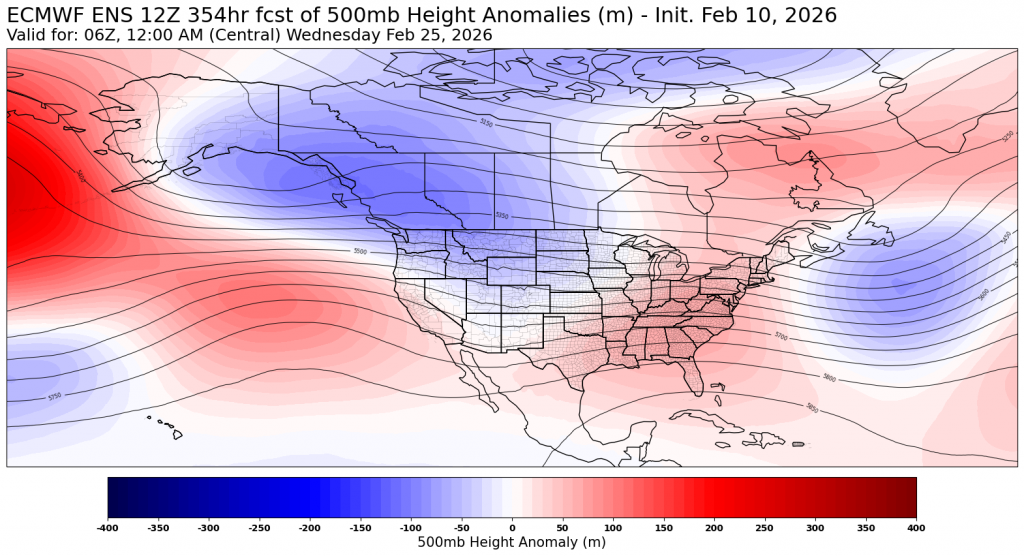
That’s where the GFS forecast stops. That GFS forecast was only a singular model run, so far our there may also be some artifacts that don’t end up happening. We can fix both of these problems by switching to the ECMWF ensemble. Through the whole scope of the GFS model we just looked at, it is surprisingly quite similar, even far out. The ECWMF ensemble does go 5 days farther, so here’s a map for then:
As you can see, it’s more likely than not going to take until March to get rid of this cold wave.
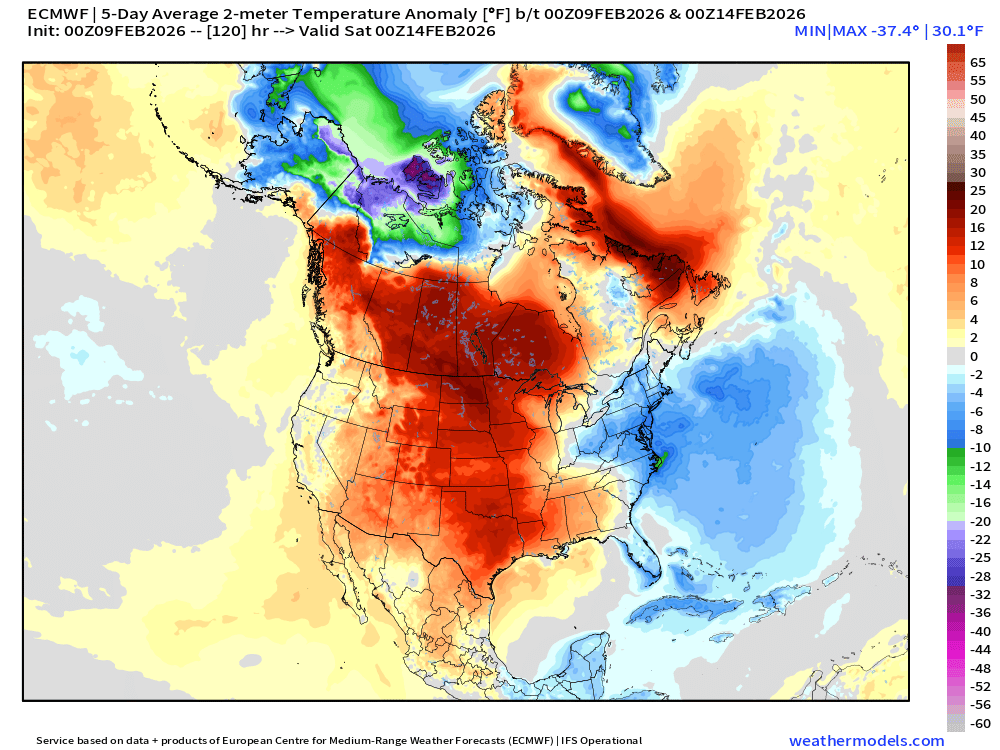
Finally, let’s look at some temperatures. We’re back to singular model runs, this time using the mainstream ECMWF model. Here is the temperature anomaly for the next 5 days:
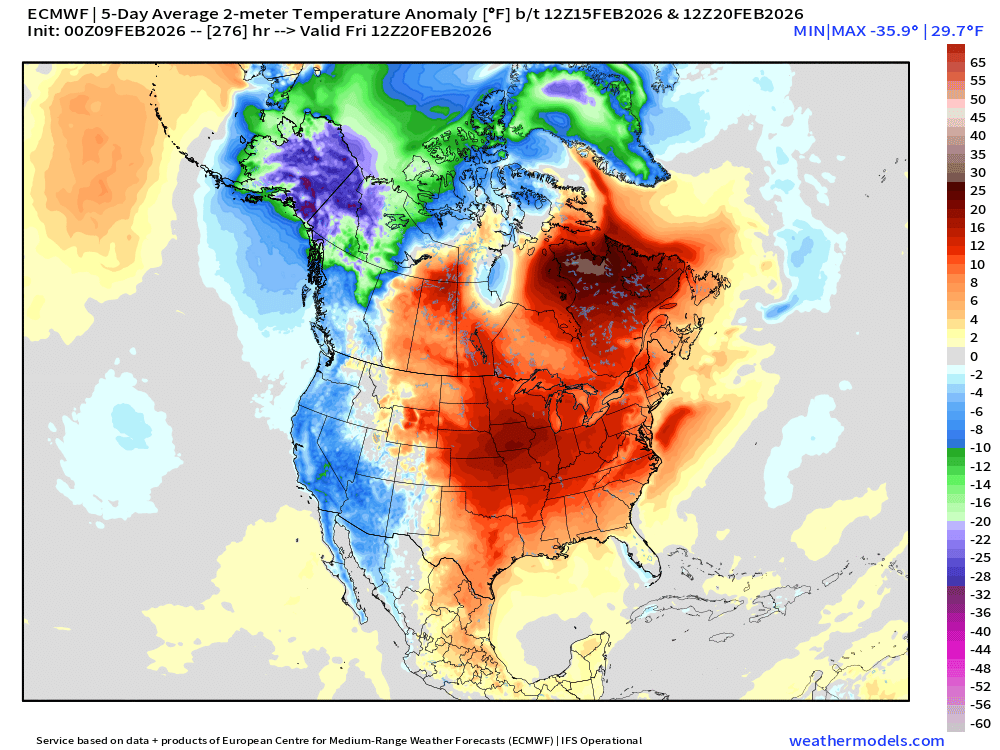
As you can see, quite warm for us. Now, let’s look at the time frame for the Feb 15 – 20:
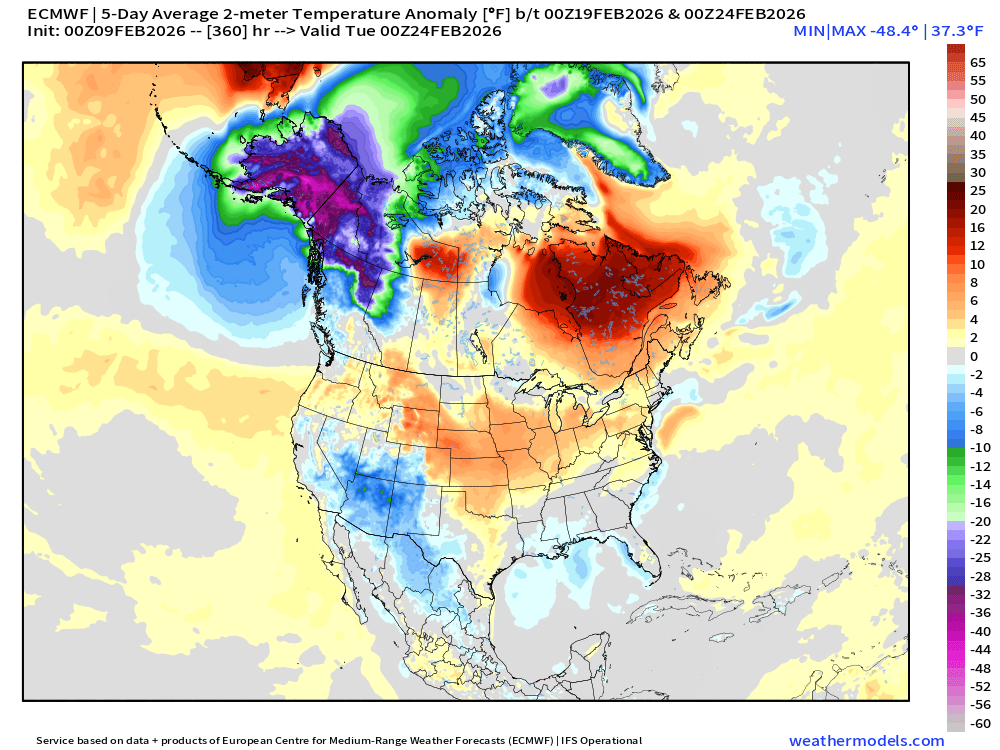
Also above average, but much less so. Since the cold seems to be approaching us, we will probably start that time frame above and end below. Finally we go 5 more days ahead and we get this:
Looks like that cold is seeping in!
If we keep going, we’ll have to use some extended ensembles, which are not too accurate, and I won’t show them here. They do seem to be forecasting temperatures to get progressively colder over the month, before then maybe a weakening in March.
Before I leave, I do want to make it clear that at the start of this cold wave, a lot of snow has been forecasted, repeatedly. It is still definitely not close enough to really make any confident predictions yet. While we’re speaking of precipitation, for during the cold wave we are also still too far away to make any predictions about a December-like clipper track making a comeback, but it is still far from out of the cards. If we got that again for a good few weeks, we would be in for quite the messy March and April; just as bad of ice as the last month has contained.
Here you go, the first post during winter break. Temperatures thus far have stayed cold and will continue to do that for the rest of the week. Right now though, our eyes are on tomorrow, when a good system will come through and bring possibly warning-level amounts of snow.
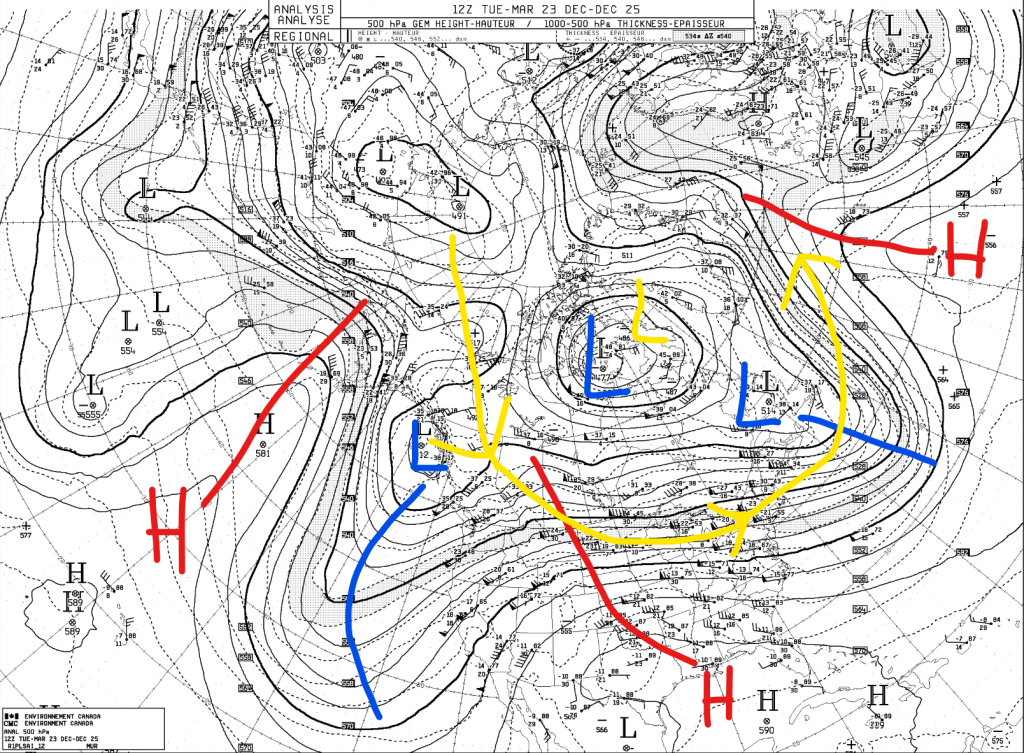
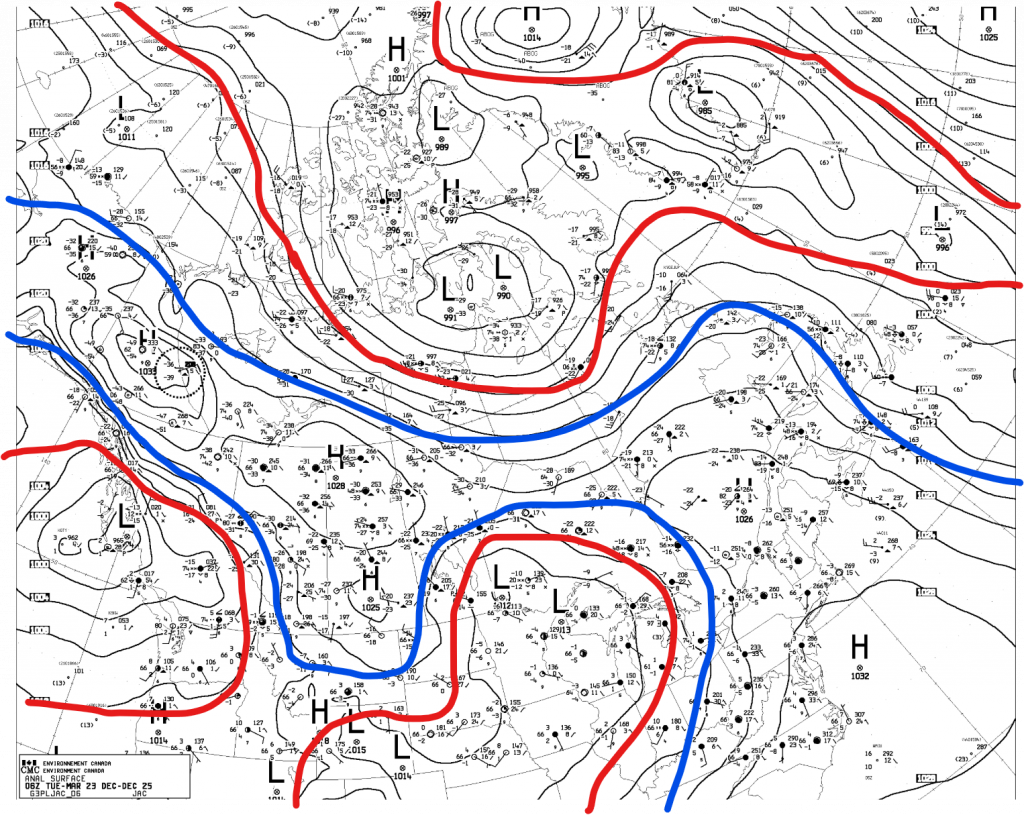
We begin right now, with upper air analysis and surface analysis maps from Environment Canada:
On the left map, we can see the overall flow at 500 hPa. We still have our now multi-week triple upper-low system over Canada, with an anchoring low in Nunavut, and two digging lows over the BC coast and the Maritimes. We also have upper ridging over the Bering Sea, the Prairies, and the eastern Atlantic. The yellow line is where the polar vortex is, and the yellow L is the stratospheric low anchoring it. The most below average temperatures are along the yellow line.
On the right map, we have surface analysis. I have outlined areas of high and low pressure so you can see them better.
Now for the forecast. To begin, we will have to look at the low in the bottom left of the right image; the one around the coast. A shortwave trough is going to develop on the coast of the US from this low, and will quickly overpower it, turning into a deep system. It will continue to run up the coast, but once it hits Canada near midnight tonight it will split: A weaker trough off the southern BC coast, and a stronger one in the SE corner of BC.
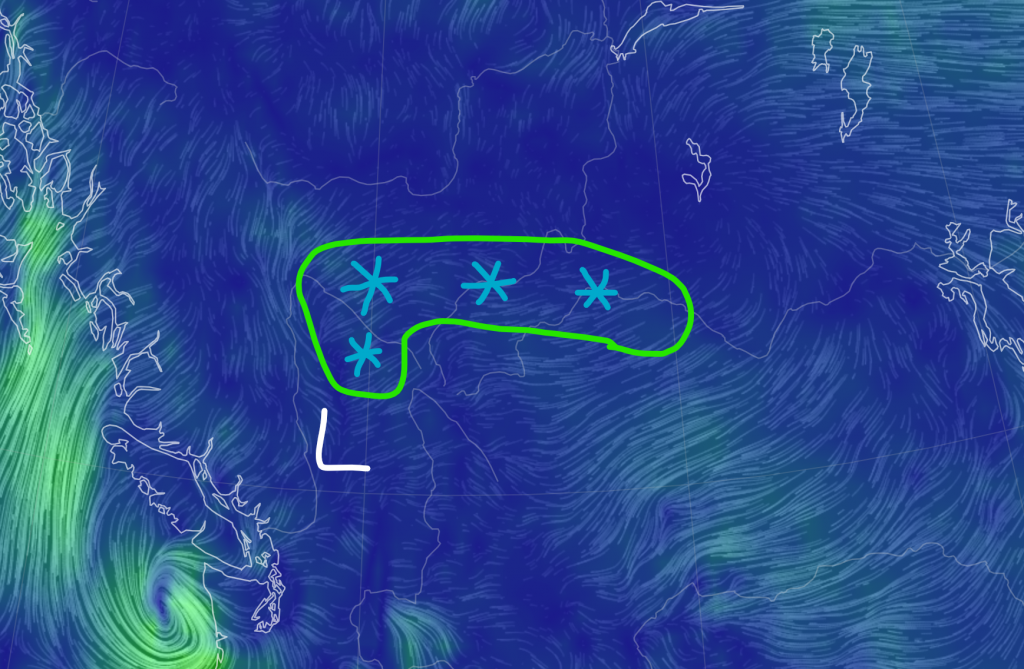
This low will then get stalled as it runs into the big mass of high pressure over AB-SK-MB, but the cloud will not. Over the day tomorrow, the cloud associated with the system will continue to move northward, and the area of precipitation will turn into something like this by the evening:
By the way, ^^^that is another low running up the coast. The other trough that split off from the main one will disintegrate by midday tomorrow.
This snow that comes through will be very heavy, and will accumulate quite a blanket. As your actual forecast, expect snow to start sometime in the morning (between sunrise and noon), and end sometime in the evening. Accumulations are 10-20 cm for central Alberta (enough for a special weather statement to be issued yesterday), with the best chances at yellow snowfall warnings being situated in the Edmonton and Lloydminster areas.
One more thing, do not fret about drifting or even blowing snow. We are still going to be under the influence of the high, and the low is also far enough away that the stronger winds will not reach here.
Hello there! Likely one of our biggest systems this winter is arriving tomorrow. On the forecast is blowing snow, very low visibilities, and most of all 10-25 cm of snow.
It will all start tonight, as a low enters southern Alberta. Usually snow will fall a good distance northward of a low, so even though the low is in southern Alberta, the snow is here. Even though we are getting very extreme amounts of snow (for December), this system is actually still a clipper. A confliction between warm air from the south and cold air from the north will create a strong stationary front, where a lot of snow will fall very quickly, and stay for about 12 hours. 12 hours is quite long for a clipper.
Total amounts of snowfall depend on where this boundary is placed. Canadian and European models have agreed extensively that the most snow will fall right over Edmonton, while US models have put it farther south. These models, however, have slowly been moving the snow northward over the last 24 hours, so most likely the Canadian and European ones are correct. I would say we have a 90% chance of >10 cm of snow falling, and about a 50% chance of >15 cm. Continuing, 20 cm of snow has about a 30% chance, and 25 cm about a 20% chance. It is only until we get to 30 cm that the chance falls below 10%.
When will this snow fall? Light snow will begin overnight tonight, then quickly turn heavy by sunrise. This heavy snow will continue all day, before diminishing tomorrow evening to a standstill at midnight. Relatively not that long, but for a clipper very lengthy.
There is also a risk of blowing snow tomorrow morning. Winds associated with this system will start overnight tonight coming from the northeast, then switch to more northerly and less intense around noon. Winds will be on average be around 20 km/h, with the strongest gusts possible above 40 km/h. This snow will definitely drift quite a lot. Temperatures will be between -10 and -20 for the duration of the snowfall, so wind chills are quite a concern.
So there you are. This snow will be quite impactful, so be aware of conditions tomorrow. Temperatures are going to go down and stay down for a while, so this snow isn’t going anywhere until spring.
It’s been a while since the last short-range forecast. Actually almost a month. Today, the drought will finally end, as some very, very cold temperatures are coming over the next few days, with a good amount of preceding snowfall.
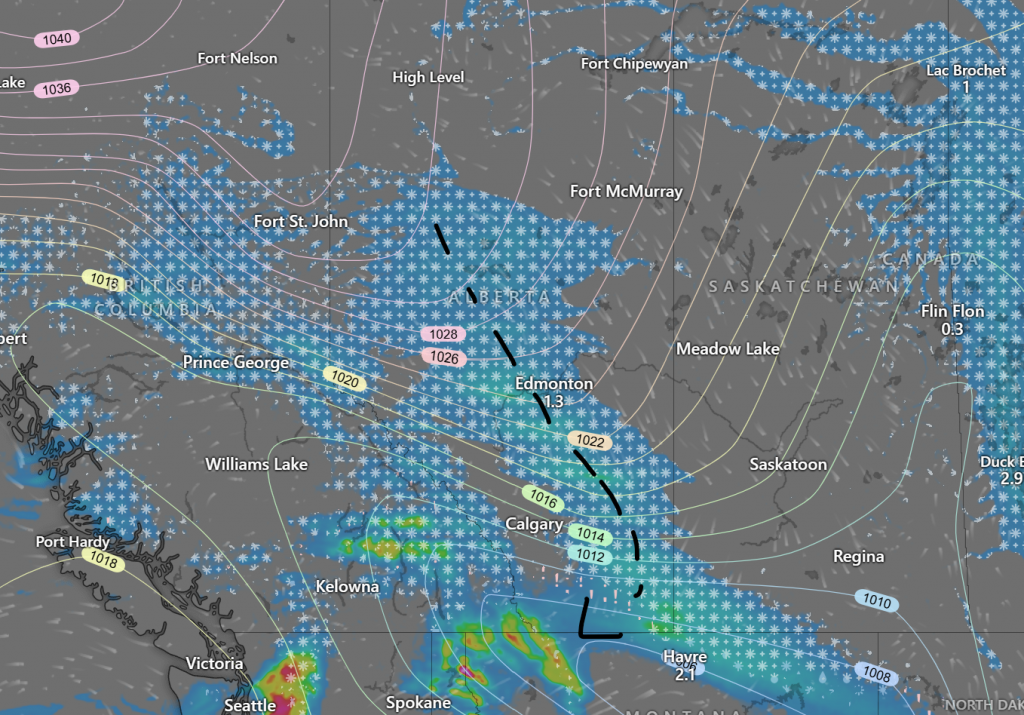
Part 1: The snow. Starting likely within an hour or two of midnight tonight, some snow will start. It will be very steady, and possibly quite heavy and visibility-reducing. The reason for this is a low moving through southern Alberta, and a band of precipitation extending northward up until about the latitude of Peace River. Windy.com is the only website I know that shows HRDPS (High-Resolution Deterministic Prediction System, very high-res model operated by ECCC. It is the best for these kinds of precipitation situations) maps. For some reason, nowhere else it is shown. So, here’s a map from it:
This area of snowfall will be quite heavy, but certain east-west bands may become even heavier, so though most forecasts put down something in the 3-6 cm range, a lot more cannot be ruled out. This snow should be mostly over by sunrise.
Through the isolines on the map, we can see a lot of this precipitation is attached to a ridge, coming up from a large thermal high in the north. This will be bringing down extremely cold air.
Part 2: The cold. After this area of precipitation leaves, air even colder than the stuff we have right now will rush in and try to battle the normal daytime warming, and it seems it will be just close enough to keep the temperature almost exactly the same from sunrise to sunset tomorrow; somewhere around -22 or -23. As a very cold high pressure system approaches from the north, skies will clear and winds will (partially) subside. This creates the perfect conditions for extensive nighttime cooling, and with the temperature already starting at -23, we will be plunging into quite the deep freeze.
Through the evening, temperatures will drop to most likely somewhere between -28 and -32. Even with the very minimal winds, wind chill values will be approaching, if not just barely succeeding -40. -40 wind chill is definitely enough for a yellow cold warning, so one will probably be issued sometime tomorrow. To mention are that some models are seeming to be “sticky” with the low being significantly away from -30, wanting to stay around -26 (Environment Canada, mainly) or -35 (A few Canadian models). It’s on every run for these models, while all the others stay near -30.
Well there you go. That’s all I have for you. Stay warm, and don’t get frostbite!
After Thursday, this week has been quite cold. Temperatures have gone down quite a lot, and snow is here as well. Today when the sun was up, the temperature varied from -17.2 to -15.7. A high of -15.7 is definitely quite abnormally low. Current forecasts suggest this is only the beginning.
Here are the current temperatures, with a bunch of numbers sprayed all over it so you make sense of it:
Those -40s up at the top are a big mass of cold air anchored there. Winds are sweeping this air across the country. The 5s and 10 you see in the bottom left are an area of upper-level ridging. If you take a close look, you can see winds coming out of that area currently extending all the way to the eastern edge of the Rocky Mountains.
As we can see here, we somewhat have a battle of warm and cold: Warm air is trying to move north from the ridge, and cold air is trying to move south from the mass of it in YK/NT/NU. The actual systems that are moving that cold air down are the lows on the very active storm track we currently have. This is expected to be the pattern for the next little while for southern Alberta and BC. Warmer, but when a low moves through, temperatures drop. Thus, an alternation of above and below normal. We, however, are far enough north that the warmth is not the dominant factor. For us, it more of an alternation of mildly below normal and record territory. Yes, record territory.
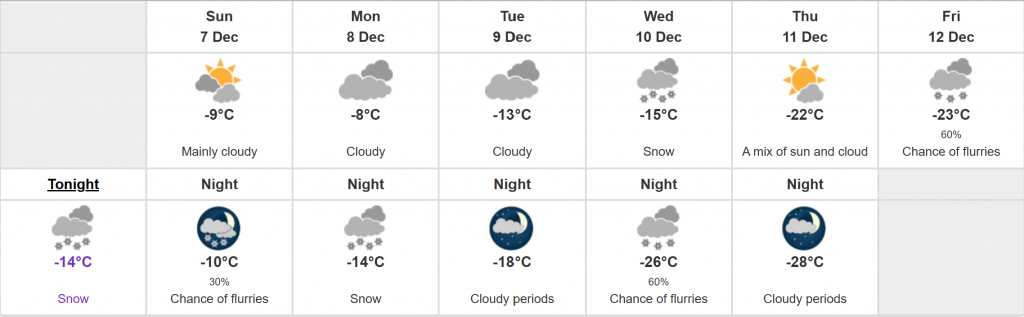
This brings me to the forecast. The actual large-scale system behind this is pretty boring, basically a continuation of what I just explained in the last paragraph. For the forecast for specifically us, things get quite interesting. To start, here’s Environment Canada:
Like I said, a wave of mildly below normal (Sun/Mon), and record territory (Thu/Fri). Those highs are definitely record territory, but a low of -28 isn’t. Other forecasts have -30s for Wednesday night-Friday night.
Now let’s look at an ensemble model:
This is the Canadian one, GEPS. Ensembles wash things out as they go on, so I’ve drawn arrows for the likely temperature patterns. It has the 25-75 percentile actually getting quite close to -35 Thursday night. Even ensembles amplify temperature events as they near, so we might have a shot at getting it. -35 is definitely record territory.
Operational models also have extreme cold, and the most extreme of them, ECMWF, has us getting within a few degrees of -40. I would say we have good chances at both a minimum low and minimum high records, with temperatures to beat being around -35 and -25.
The very interesting thing about this cold wave is that we will still stay active, and the semi-clippers that we have (semi because they are tracking over us quite slow, then speed up as they exit Alberta) will continue to ring good amounts of snow repeatedly.
One more thing, we have no idea when this cold wave will end. The best thing I can say is that there is about a 90% chance of us still being in it in 10 days.
Happy December! For a quick version of the upcoming forecast, we will be probably quite snowy with a lot of temperature variation and uncertainty.
If that’s all you came for… Well, bye I guess? For the rest of you, read on for details.
This month, what are the overarching oscillations that will likely affect us? First of all, La Niña.
As you can see, we are currently at a -1. Since September (actually even earlier) It has been very slowly strengthening, but in the last week has started to weaken. I would expect the -1.2 we got about 5 days ago to be the peak of this year’s La Niña. Towards the end of winter, we might actually end up pretty close to neutral.
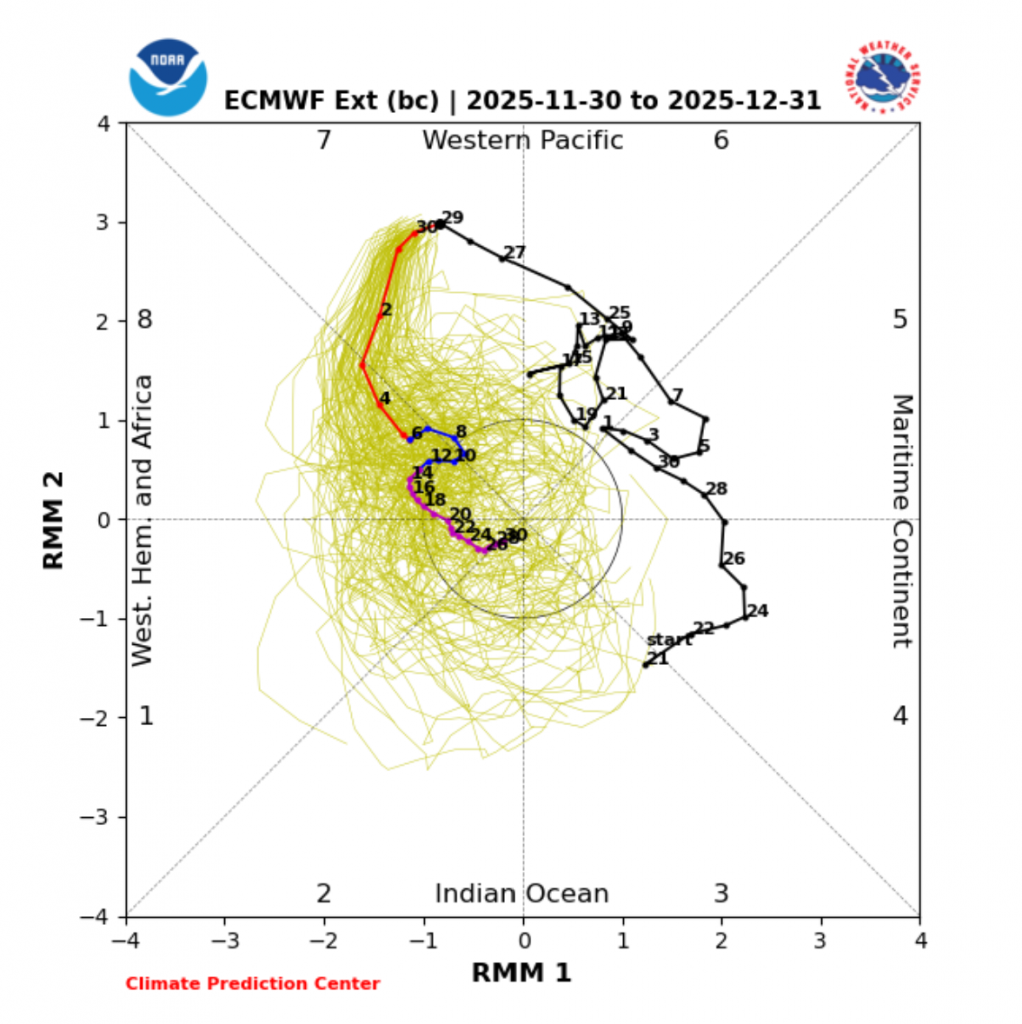
Related to this, we have the Indian Ocean Dipole. For a while now, it has been a battle between the two, with La Niña’s easterly winds and the negative IOD’s westerly winds meeting in the middle and causing the MJO to be stuck in phases 4-6. Why is this? The MJO is just a question of where is rising motion in the Indian Ocean and west Pacific near the equator. Around Indonesia is Phases 4-6. 7/8 is the west Pacific, and anything below 6 is in the Indian Ocean, with 1 being almost at Africa. The converging winds are just causing the rising motion.
The Indian Ocean Dipole has been quite negative for a while, but in the last two weeks weakened extremely fast and is now near neutral:
Finally, the MJO. It seems the expulsion of westerly Indian Ocean winds will cause the MJO to shift to more Phase 8, then slowly dive. These phases are usually bringing of cooler, more active weather than 4-7.
Now for the actual forecast. This week, temperatures are varying a lot, and a lot of snow is forecast. Both of these are likely good analogs for the entire month.
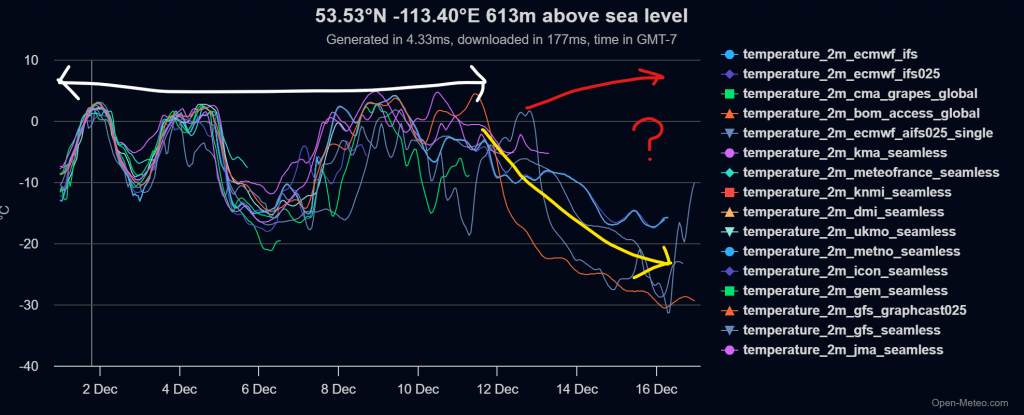
Here is a good graph for a bunch of different models and their temperature forecasts:
Everything under the white arrow is somewhat certain. You can get a good look at what temperatures will likely do over the next while. Throughout at least the next week will be very active and snowy, and there are currently no signs of that stopping soon. After the 12th, the models suddenly take the temperature way down, but that’s not for sure. What the red means I will get to soon.
Now, what is the pattern governing the above graph? For this week, it is this:
On this map, the yellow is the surface wind direction, and the green is the storm track. We have cold air the north and east, and warm air to the west and south. The barrage of lows expected to pass through over the next 5 days will create great day-to-day temperature variations.
Next up, the second week of December:
Now what we see is that the high has snuck into the US and cooler air stretches in a band from Alaska to the Maritimes. We will likely still stay active, and also more windy.
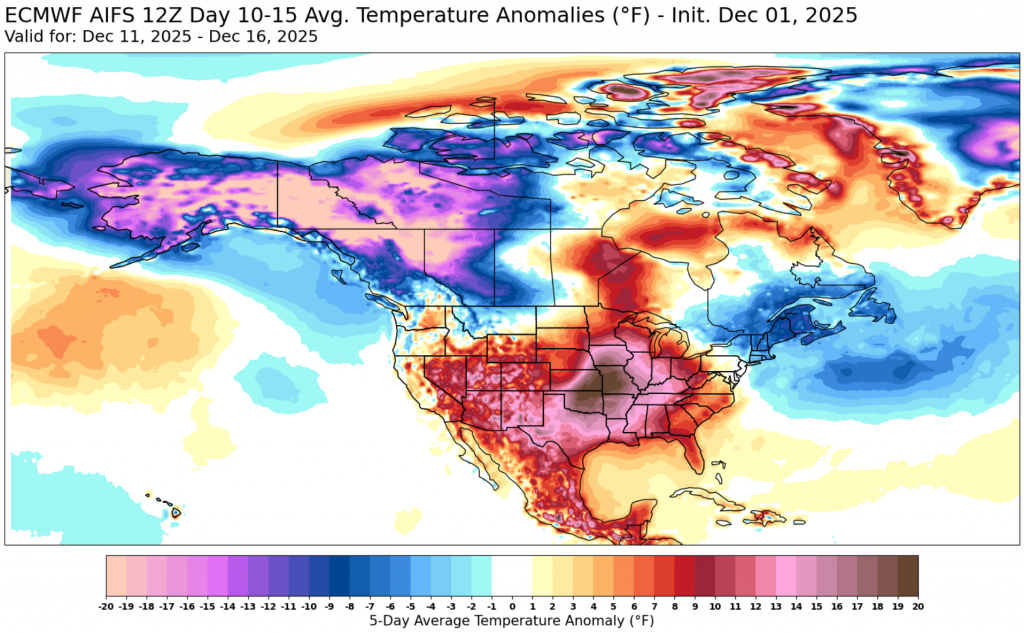
Around the 12th, we see a divergence. A lot of operational models but a big blast of cooler air down. The most aggressive of these right now is the ECMWF artificial intelligence model, AIFS:
It’s in Fahrenheit, but that difference from normal for us would be around 7 degrees below normal. That would likely mean lows getting close to (or maybe even beyond) -30, as events like these get amplified as they near.
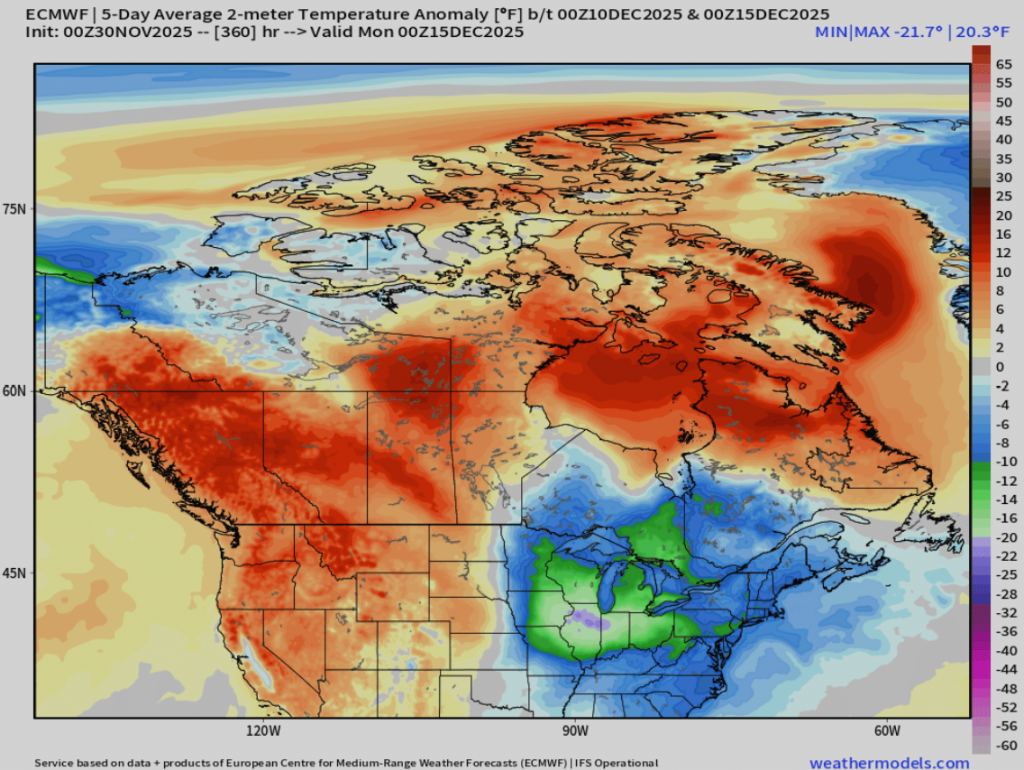
The other side to this are the sub-seasonal models. They give us a heat wave and focus all of the cold in the east. The is a map for December 10-15:
This puts down much warmer air. Note that it does not stick; but rather these models put a blast of cooler air from the beginning of winter break to the beyond the end of the month.
As well, both the operational and sub-seasonal models have high amounts of precipitation, despite the temperature differences. I would say it is more likely that we have a snowy month, but that doesn’t mean it will be. Entire seasons often get characterized by just one or two events, or lack thereof.
So, our final prediction for December is:
Variable, but mainly cooler temperatures, and most likely lots of snow.
Starting Monday, a large pattern change will occur and we will dive to quite possibly well below normal temperatures.
To begin, we’ll talk about why. For the last many months low pressure has dominated the first 1000 kilometres off the west coast of Canada and the US, but now that is changing.
Here’s now:
Here’s a week from now:
Right now, low pressure dominates in the eastern Pacific, but a large transition will take place around the weekend, where a ridge takes that place. At this time of year, a ridge in the eastern Pacific will disturb the polar vortex (especially when it is weak, like right now), and cause it to rebound just east. This means a sudden shot of cold air. The Pacific ridge will strengthen fast over next week, and keep cold in place for quite a while.
So it was pretty simple why, so next we have to investigate the structure of the cold wave. I would guess starting Monday, temperature will begin to drop, but it wont be very fast. Only a gradual decrease of 3-5 degrees a day. Temperatures will likely stabilize around Wednesday, and stay stable for the rest of the work week.
From the 29th on, models currently diverge considerably, but the main pattern is still on most. Expect a quick ~2 day shot of even colder air, probably bringing the coldest of the cold wave, before a very rapid warmup, staying warm for about another two days, and then a possible return to cold. The exact timing of all this currently varies from starting the 29th to starting the 1st.
During the shot of even colder air, current model differences are generally between -15 and -30 for a lowest temperature.
Now finally, the snow. The begin the cold wave it seems we will have a system move pretty much straight across the entire prairies from west to east. Another system will also come up form the US and interact with it. Here is a map, to help you make sense of this:
These two lows will interact and possibly merge. If they do, the prairie low will get stalled before, and give us a lot of heavy snow. If they don’t get close enough to each other, then the low will more act as an Alberta clipper, and only give us a dusting of snow. Right now, model differences generally put down between 1 and 10 cm of snow mainly Monday morning through Monday night.
For right now, that is all you need to know. Be prepared for the cold!