This week’s forecast: A whole lot of CCC

At the moment, the jet stream is kind of all over the place. Roughly though, it’s overhead-ish.

As we look into the week, we can see lots of storm potential. In fact, every single day for the rest of this week probably has an >30% chance of us getting a thunderstorm. This is because of the same reasons of all other stormy days we’ve had in the last month or two. We have warm and cold air mixing together and creating instability, a close jet stream, and no blocking patterns.

A thing that will be paired with the storms this week is more low 20 highs, like a lot of what has happened so far this summer. The ridge will move eastward, and a through will come in its wake. It has already appeared in northern BC, and will dig its way down all the way to Montana this week, and will likely cool temperature down by about 5 degrees, starting Wednesday. The low will also bring clouds, so the second half of the week, mainly Thursday and Friday, will see semi-overcast skies.

Now what about precipitation? Just like what we had over the weekend, most of it is going to be from storms. This means precipitation will be very variable, just like how in the last 48 hours Stony Plain got over 20 mm, while my house probably got about 1.

That is it for today. If you want more details, just wait for my email forecast this evening. If I end up busy, then maybe tomorrow evening.

Posted in Forecast, Precipitation, Temperature | Leave a comment

Great severe thunderstorm potential tomorrow into tomorrow night

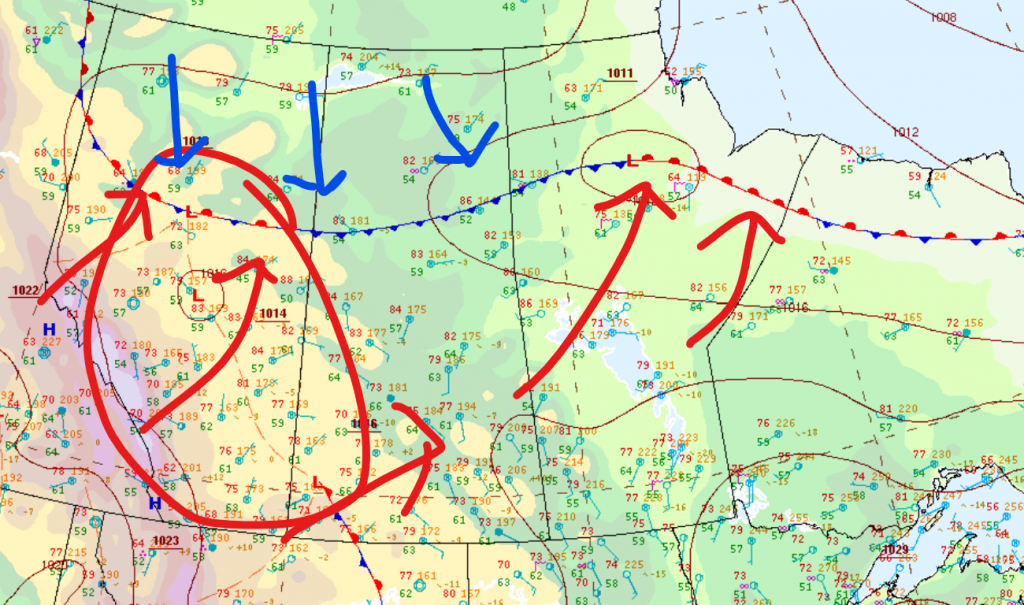
Tomorrow afternoon, evening, and overnight; we will have very good chances at severe thunderstorms. Today, we have a chance at a thundershower, though it isn’t really too much of a chance. We might only get a quick shower this evening, if anything. As we look towards tomorrow though, instability will become way way higher. Here is a surface analysis chart with some overlaid stuff I’ve out on it. It is from noon today.

As you can see, we have low pressure over Alberta (the red circle), as well as a very long frost going off the the east. The red arrows are warm air, and the blue arrows are cold air. If you know anything about what causes storms, you would know they need instability in the atmosphere, and the usual cause for this is a clash of warm and cold air. So as you can probably infer, the area around the stationary front in northern Alberta is where we’ll see the most storms today. The most common cause for storms here is warm air flowing over the Rockies, which causes lots of instability and storms generating in foothills before moving off through the prairies. It might seems like that is happening here, but there’s one problem. For the storms to actually move anywhere, they need the help of the jet stream. Currently it’s tied up in being a ridge right now, so the storms can’t move eastward. This means we probably won’t see any storms today, maybe only if a local cumulonimbus pops up.

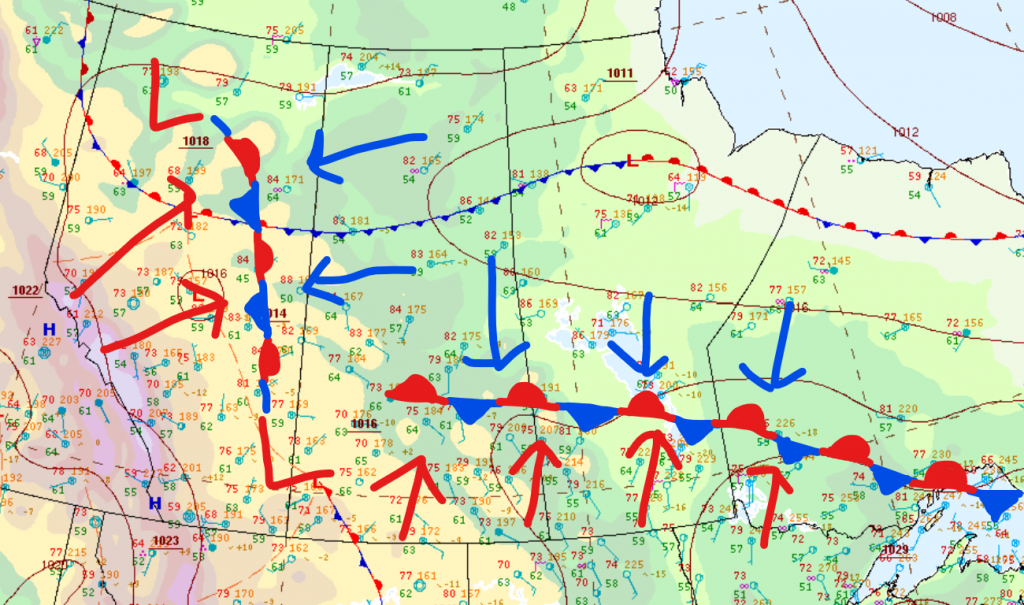
Next, here’s what is expected for tomorrow at noon, overlaid with the same map:

As you can see now, we have mainly two lows, with lots of warm and cold air mixing over central and southern Alberta, central and southern Saskatchewan, and southern Manitoba. The low we’ll be looking at is the southern one. Around here, there will be lots of moisture, meaning on mostly the northern side (because that’s where the stationary front is) there are very good conditions for severe thunderstorms. This low is actually going to move northward very slowly through the day and night on Sunday, meaning from mid afternoon tomorrow to overnight tomorrow night, we have a quite prolonged chance for severe thunderstorms.

In wake of this, starting on Monday, we will probably see good chances for thunderstorms every single day next week, since the jet stream will be near and instability holds.

Posted in Forecast, Precipitation | Leave a comment

August forecast: Will the pattern continue?

It’s a new month! Here’s what it may look like, divided into 5 sections:

PART 1 (1st – 2nd)

This part consists of today and tomorrow. As you probably know, these two days will be the final days of a heat wave we’ve had for a little while now. Highs will probably be right around 30.

PART 2 (3rd – 9th)

It seems after Saturday we will return to normal temperatures, but far from quietly. From Saturday night to Monday, showers and many storms are expected. After that, it seems thundershowers will probably continue as temperature follow a slow cooling trend down to below average. This is caused by the jet stream being near overhead as the ridge we have now will depart to the east.

PART 3 (10th – 13th)

It seems around here we might see a short heat wave as an upper-level high pushes up from the US, cause some ridging.

PART 4 (14th – 20th)

After the heat wave, we’ll probably once again go into our CCC state, but afterwards is when it gets a little fuzzy. It seems one of two things will happen. Either we stick with our pattern of alternating short-lived heat and cold waves, along with frequent storms; or we might end up in a drier and (maybe?) warmer anomaly. Currently it is hard to tell.

PART 5 (21st – 31st)

Here is where the most uncertainty is, as can be expected. This part may end up being pretty below average, though that’s not for certain. Near the end, there is a pretty good chance for a larger heat wave, which may continue (but more likely start) in the beginning of September.

Now, here are some things to expect for the month as a whole. For temperatures, we’ll probably end up near normal overall. For wind, it’ll probably be the same as July: Calm some days, windy most days. In terms of precipitation, there will very likely be a lot of variation, depending on where storms hit. Some parts could see only 30 or so mm for the whole month, while area only a handful of kilometres away could see well over 100. Finally, for smoke, I don’t think we are going to see too much. The areas where we usually source our smoke (northern Alberta and southern NT) look like they will get lots of rain.

One more thing, about the July recap, that will come sometime soon, but not today. It turns out the websites I use need a few days to collect all the data from the models.

Posted in Forecast, Precipitation, Smoke, Temperature, Wind | Leave a comment

Heat wave update: It’s much shorter than we thought

Back on Wednesday, I said that there was a possible larger heat wave coming this week into next week. So, this week is this week, meaning it’s time for an update.

For the next few days, not much has changed since then. We still have the low sneaking its way into the Gulf of Alaska. We still have a blocking high in the southern US which is ridging up to here. The main thing that has changed is what happens after Thursday.

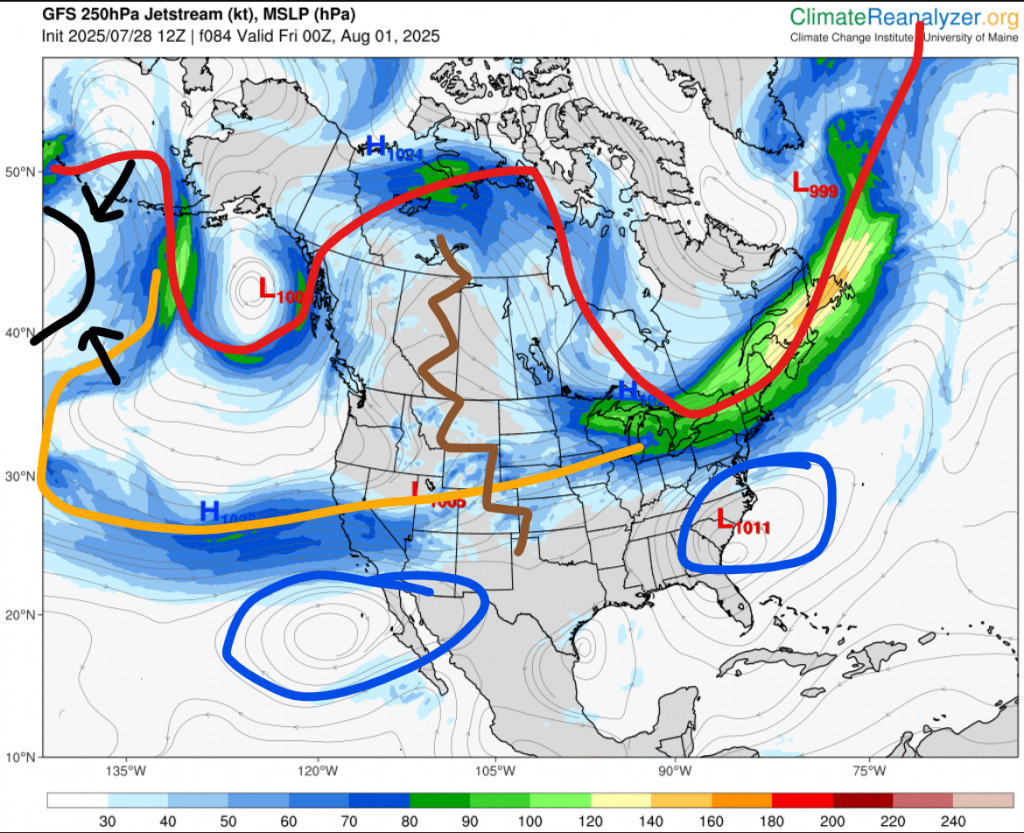
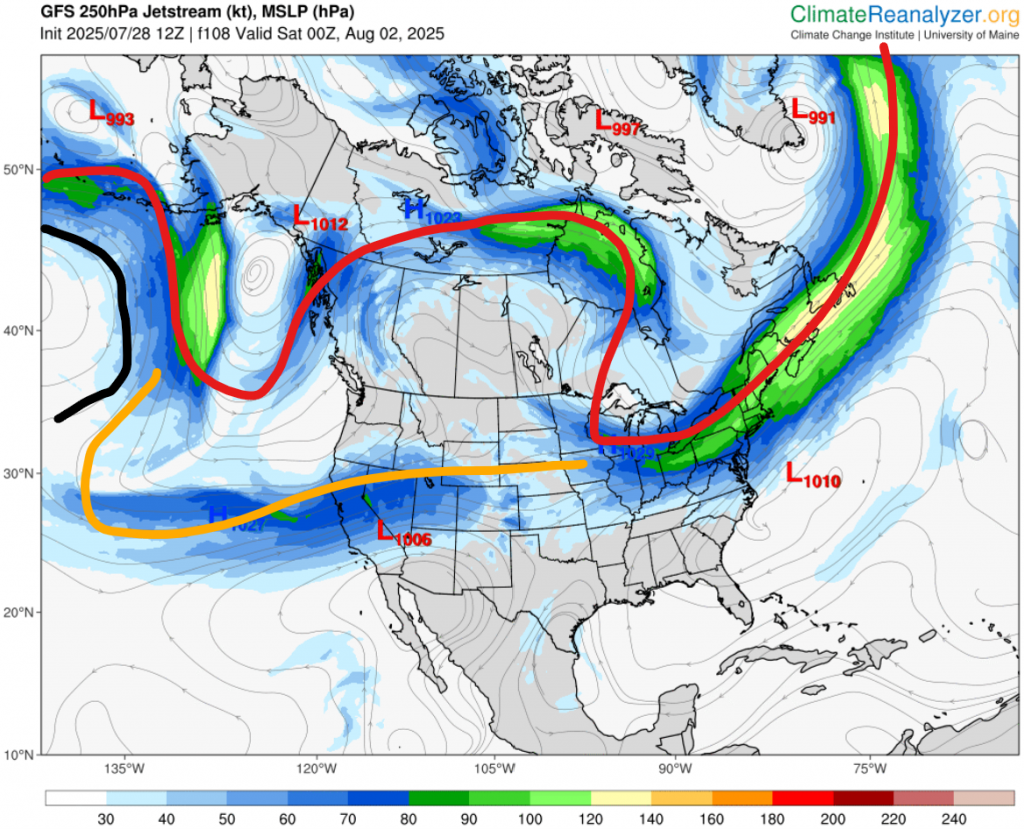
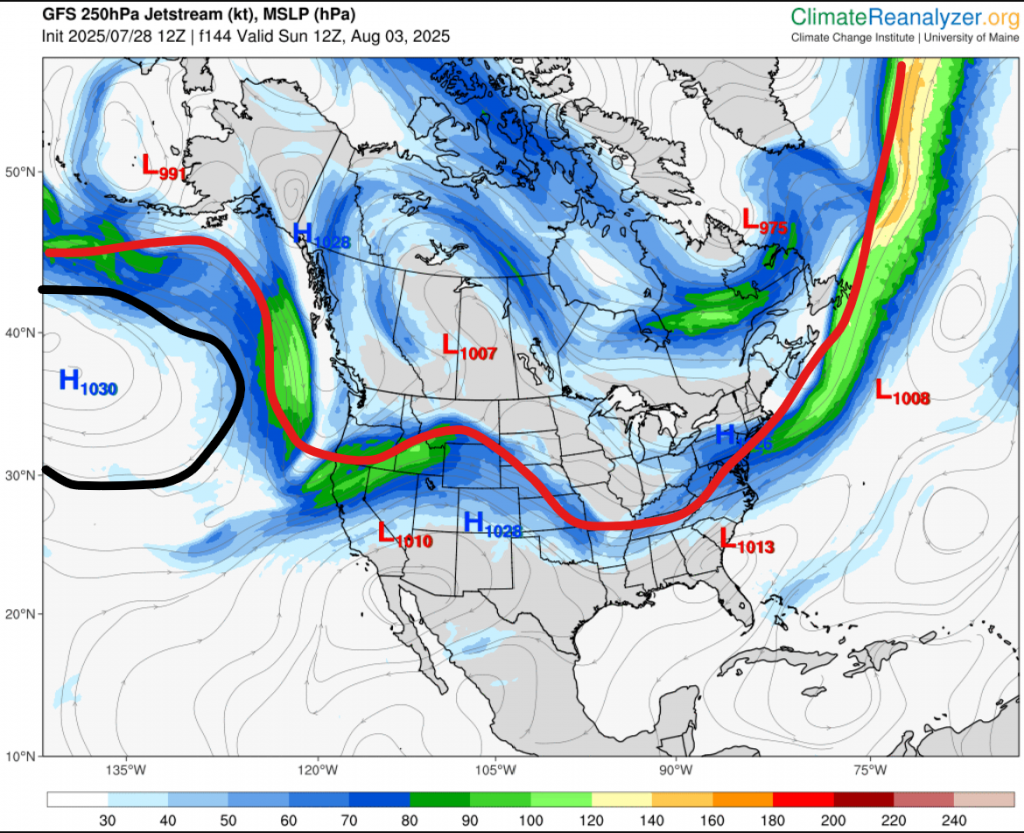
First of all, let’s look at Thursday evening, which is the first picture. I have laid out where the polar jet stream and subtropical jet streams are. You can see the classic omega block pattern. At this time we have not one, but two blocking highs below the subtropical jet stream, which are collectively enforcing a ridge (zigzag line) up to Alberta. What I really want you to take notice to though is the Pacific high. That is the one on the left with the arrows pointing to it. Now, look at the second picture. This one is for just 24 hours later. Notice anything different about the Pacific high? Yes, that’s right. It’s expanding to the west. If you go to the third image, this time on Sunday morning, you can see the jet stream has gone way south and we are now in a cold wave.

Next, let’s move to what the actual temperatures may look like during the heat wave.

Expected highExpected low
Monday~20Low teens
TuesdayMid 20sMid teens
WednesdayHigh 20sMid to high teens
Thursday~30High teens
Friday~30Mid teens
SaturdayLow to mid 20sMid teens

Finally, precipitation. Besides today, the work week looks bone dry. Only when we get to Friday night there are some possible showers and/or storms.

If you want to know what next week and beyond will be like, then you won’t have to wait long! I will post an August outlook later this week.

Posted in Forecast, Precipitation, Temperature | Leave a comment

Another wave of CCC weather this weekend!

This weekend because of low pressure and the western side of some zonal jet stream flow over the area will cause temperatures about 4 degrees below normal, partly cloudy to overcast skies, some scattered showers, and we can’t rule out some isolated thundershowers.

So, how much rain are we thinking? I would say probably something like 5-10 mm. Maybe more though. A lot of this is hit-or-miss showers, so it is possible we only get something like 3 mm, but also just as possible that someplace in the city gets 20. For the timing, I would say we’ll probably start with some showers or thundershowers in the afternoon/evening on Saturday, followed by some showers continuing into Sunday. Which should be over by Sunday evening.

Posted in Forecast, Precipitation, Temperature | Leave a comment

A heat wave could be on the horizon…

The following material may contain many terms you are unfamiliar with. This time, I’ll just let you look it up.

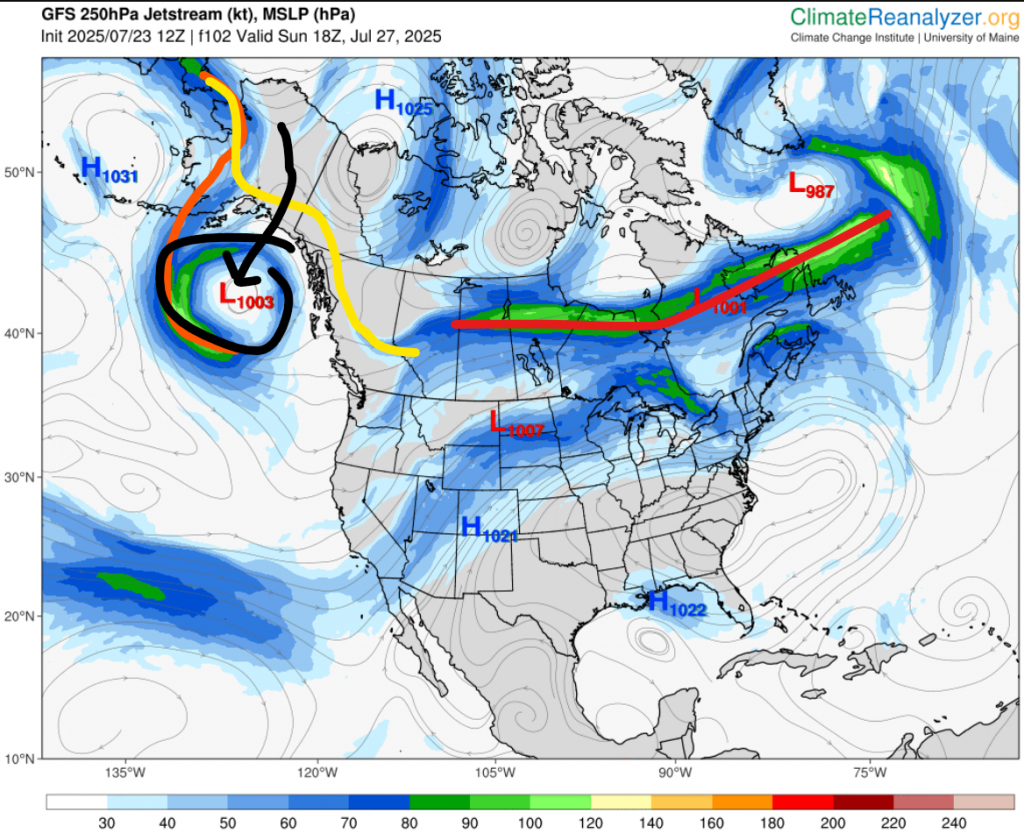
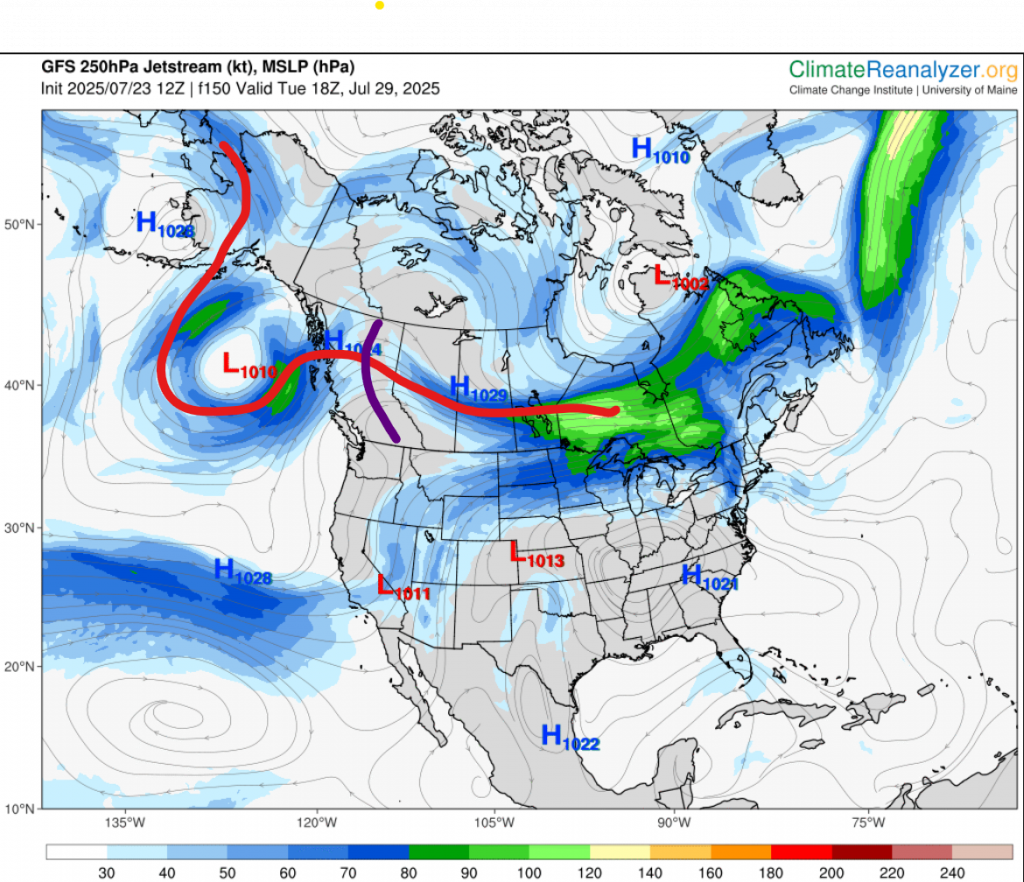
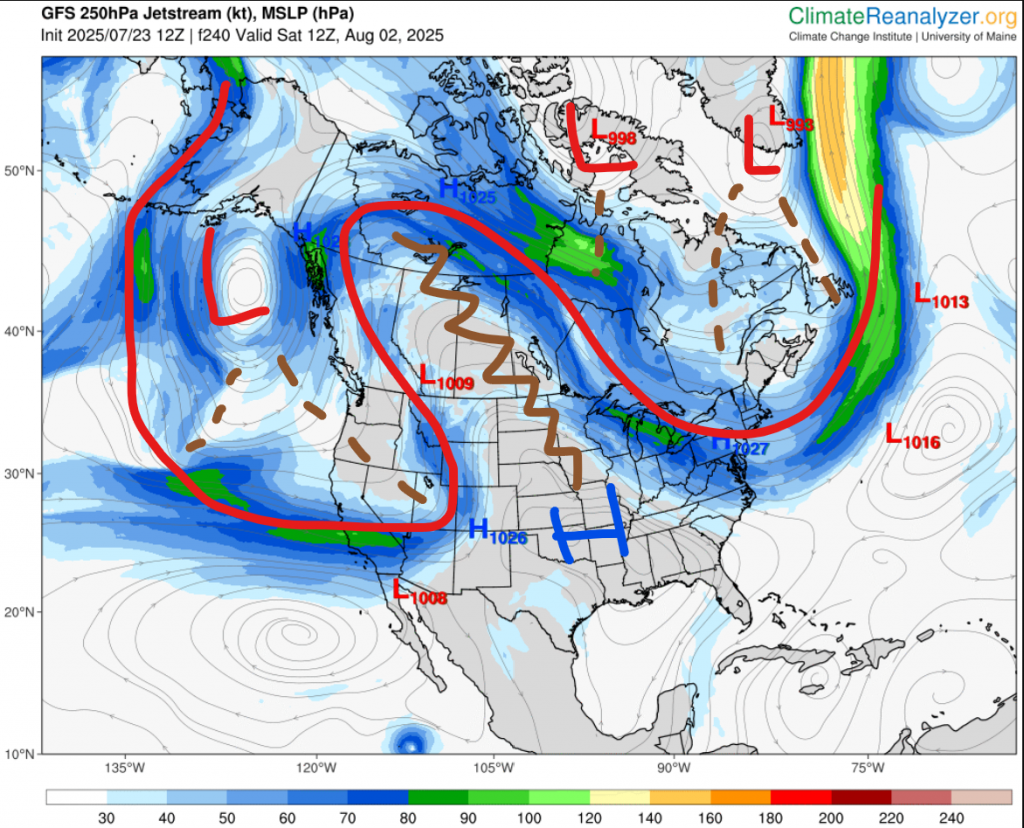
We’ve been very lacking in the heat wave department so far this summer, but it looks like pretty late in the omega block season, we may actually get something. Let’s take a look at our upper air forecasts. Here I will supply a “gallery” of images for you, to reference as I explain what’s going on. If you want to see the images better, right click them, and then press “Open image in new tab”.

First image: This is the forecast for Sunday. You can see there is a long area of zonal flow (red line). If you didn’t know with zonal flow usually is it sunny near the eastern edge, but then as you slowly go west, it gets cloudier and cloudier to point where there is rain near the western edge. As you can see, we are going to be on the western edge, and this might bring some rain on Saturday night into Sunday. The main thing to look at here though is the low in the Gulf of Alaska. As I have mentioned many times, whatever is going on in the Gulf of Alaska really controls what happens here. A high, low temperatures. A low, high temperatures. This area has been dominated almost entirely by the Pacific high this month, which is why we’ve been so cold. But, as you can see, there is a low there on the map. This low is currently forming in Alaska, and is expected to move south, before stalling in the Gulf of Alaska. The orange line is the jet stream then, and the yellow is the jet stream now.

Second image: This one is for Tuesday. Now the low is almost a cut-off low. It has caused significant troughing, which has made way for a blocking high in the southern US to start to ridge up north. This could be the beginning of a heat wave.

Third image: Now we’re at the start of the first weekend of August. The jet stream made its way all the way down to the subtropical jet, the high has ridged up more, and some lows around Baffin Island and the southern tip of Greenland has also started to trough. This means we have a full omega block.

Now, we must ask, how long will this stay? Well, here’s the interesting thing: It seems the shortwave trough in the third image that is pushing southeast of the westerly low may actually push the blocking high far enough to displace it to be more centred around Florida, which may give the jet stream wiggle room to jump the Rockies at least temporarily. Forecasts have been suggesting a cooldown around the first or second day of the month, but aren’t really sure what’s going to happen after that. Some say the heat will return for another 5 days or so, but others say the omega block may move farther to the east and we’ll suddenly be in a cold pattern. Right now, it’s hard to say who’ll be correct.

For now, that’s where I’ll leave it. I’ll post a short-range forecast on probably Monday, explaining for about what next week could shape up to be.

Posted in Forecast, Precipitation, Temperature | 1 Comment

Warm on Thursday, but will it last?

Ben, is this it? After all these countless 317 days since the last legitimate summer heat wave* will we finally get one?

No.

In fact, both the preceding and proceeding days may end up with below average highs.

So let’s get right to the explanation. This heat wave, if you can even call it that, isn’t really a heat wave. It’s more of what I like to call a “fake heat wave”. Most summer heat waves will be caused by some sort of high pressure system carrying hot air moving over us. For the longer ones, usually the high will be stuck in an omega block. For this heat wave though, it’s actually a low to the northwest pulling up warmth from the Pacific high, using its counter-clockwise winds. The low is moving fast, meaning the heat will be very short lived. We’ll see a high likely in the mid to high 20s, followed by some storms in the late afternoon and evening, leading to a near-average low once again.

After Thursday, it looks like we’ll enter back into a lot of the stuff we’ve been seeing recently: cold, clouds, and could be rain. Maybe we’ll call that the CCC.

*Two or more consecutive 30 degree days

Posted in Forecast, Temperature | Leave a comment

Lots of rain to come tomorrow through Tuesday!

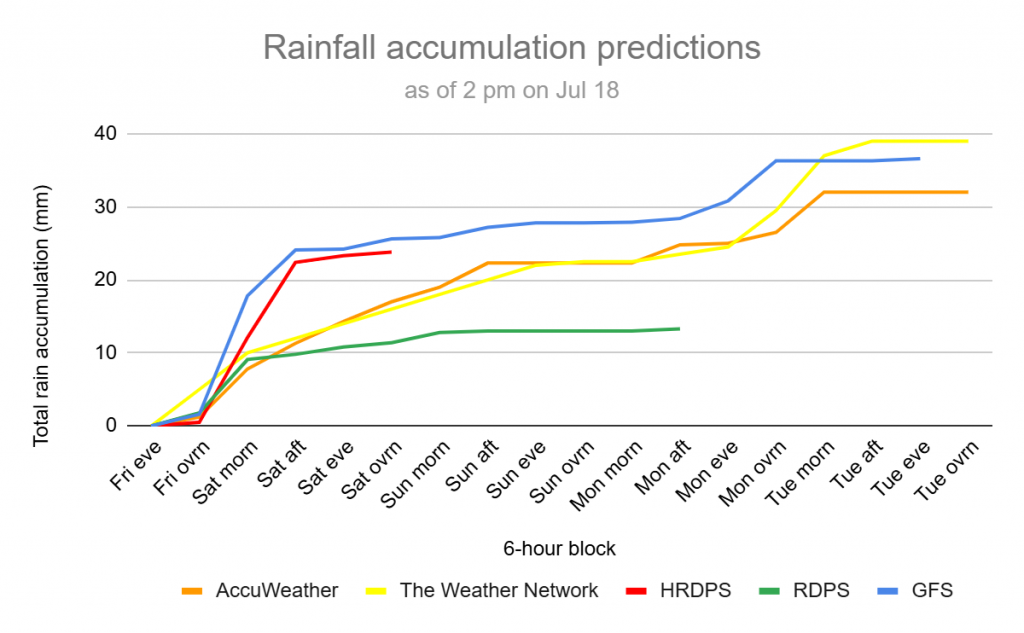
We’ve had quite a dry July so far, but soon that will change. Multiple rounds of precipitation are expected to come through overnight tonight though Tuesday morning, accumulating something like 30-40 millimetres.

To show you what different models think, here is a graph showing the expected precipitation amounts:

I didn’t include Environment Canada, as it isn’t very precise. Instead I put in three models. HRDPS stands for High Resolution Deterministic Prediction System. It is run by the Government of Canada and has a resolution of 1 km (Which by the way, is really high). RDPS stands for Regional Deterministic Prediction System. It is run by the Government of Canada and has a resolution of 10 km. Finally GFS stands for Global Forecast System. It is run by NOAA and has a resolution of 0.25 degrees.

One more thing to note, the actual data there is for the end of 6-hour block. For example, Sun morn would mean the total precipitation from now up to the end of the morning.

Now, what is causing the precipitation? If you look at the graph you can probably see the two main waves of precipitation. There’s one from overnight tonight to Sunday morning, and another Monday night and Tuesday morning. The first is a low carrying lots of precipitation from BC through towards southern Saskatchewan and eventually out of Canada. This will probably bring the majority of the rain. The second wave is a cold front coming through. This one will be coming from the Northwest Territories, where over the weekend a trough is expected to enter. The cold front will bring some precipitation, but it’ll definitely not last as long as the first wave. Of course, the cold front will also bring cooler air, but after taking a peek at next week’s forecast it might actually only bring cool temperatures for a short time before it warms up again.

Posted in Forecast, Precipitation | 2 Comments

Some smoke may come through on Wed. night and Thursday!

Some “fresh” Saskatchewan smoke is expected to take a stroll through the area on Wednesday night (maybe?) and Thursday.

If you didn’t know, the cause of our sunny skies today is a high in northwestern Alberta. If you understand anything about highs, you would know winds flow out clockwise from them. Currently there are fires in central Saskatchewan. The smoke would go to us because of the high being north of us, but remember the high is actually northwest of us, meaning the smoke should miss us. The end.

But wait. Pressure systems, or rather all weather systems go west to east. It’s called the Earth not being flat. That means when our high moves east, the winds will shift from northeasterly to southeasterly. If the smoke is already to the southeast of us, then the shifting winds will bring them to us!

Of course, the smoke not coming directly from the fires means it will have dispersed a great amount. The smoke that looks like it may be coming for us would have probably already come out of the fires 18-24 hours ago. This means when they reach us, you’ll likely be able to tell it’s in air, but it wont be very thick.

So what about timing? Environment Canada doesn’t like to go far in the future, so it’s either just Thursday or no smoke at all. AQICN says Wednesday night and Thursday. Accuweather says no smoke, and FireSmoke.ca says starting Thursday morning, and actually continuing to Friday morning.

Posted in Forecast, Smoke | Leave a comment

Where are the heat waves?

So far this summer, you may have noticed something has been absent that was very prominent over the four last summers, excluding 2022. That would be the long summer heat waves.

If we look at the last month and next 7 days, we expect to have the number of 25 degree days in the low teens, and two 30 degree days. But, if we look at the exact same time frame last year, we see 17 25-degree days, and 8-30 degree days. That is quite a significant difference. As well, last July we had 7 30-degree days in row! This year, there isn’t much of a chance for a streak beyond 3 days for the entire rest of the summer.

The true question is though, what is actually the cause of this? Before I explain that, I must make sure you know what I’m even talking about:

  • Pacific high – a high that’s basically always in the Pacific somewhere between the Gulf of Alaska and Hawaii.
  • Trough – A line protruding from a low that consists of lower pressure than on either side of it. Basically bumps on the pressure isolines.
  • Ridge – Opposite of a trough. Higher pressure line coming from a high pressure system.
  • Upper-level trough – Imagine the jet stream is an isoline, and the poles are lows.
  • Upper-level ridge – Same, but this time the equator is one big high.
  • Polar vortex – A large area of highs around the pole that appears in winter. When a high moves south, it brings January 2024.
  • Omega block – A blocking pattern that causes the jet stream to take the shape of the omega symbol (Ω)

With that out of the way, let’s get into it.

First of all, the Pacific high has been off the coast of the US. This is important, because many models (primarily European ones, for some reason) have been saying it was going to be more northward. This would entirely break the pattern we’ve been having, so definitely take the 7-day+ forecast with a grain of salt. The Pacific high has been creating quite a large upper-level ridge over the western US, which has contributed to heat, but more so severe drought.

The other thing is that the ”””polar vortex””” has been prominent over the northern Northwest Territories. It’s really not the polar vortex, because it consists of lows, not highs. Also it’s July.

Those two patterns have been very prominent over the last few weeks. So, how do they stop heat waves? Well…

Our heat waves want omega blocks. They’re the entire reason July 2024 broke so many records. The upper-level ridge over the western US really wants to bubble up and expand its territory to the Canadian prairies. Every time we’ve gotten heat over the last few weeks, that’s been this high trying to start a heat wave. What’s been stopping it is the complex of lows up north. Every 3-8 or so days, it’s been sending a low through the prairies to then spiral off to Hudson Bay. We’ve already felt this a few times; whenever in the last few weeks we’ve had 1-3 days of clouds and rain after heat, followed by a day or two cool temperatures, that been one of these lows passing through.

So, we’ve had this alternating pattern. Heat bubbles up, then moisture comes for 1-3 days, we get a very brief period of below-average temperatures, then the heat starts to bubble up again. Whenever we see a pattern that’s lasted for a few weeks and keeps reloading, then until it ends whatever the weather has been since it’s started, that will be the forecast.

So then, when will it stop? I looks like it’ll continue for the rest of the month (the only chance is MAYBE around the end). Once we get into August, it’s hard to tell what will happen. I will say, keep your eyes of the second half of August. I do see a possible not heat, but cold wave much longer than what we’ve been getting affecting us then. For now, we’ll have to wait a little longer for an August forecast.

Posted in Forecast, Past weather, Precipitation, Temperature | Leave a comment