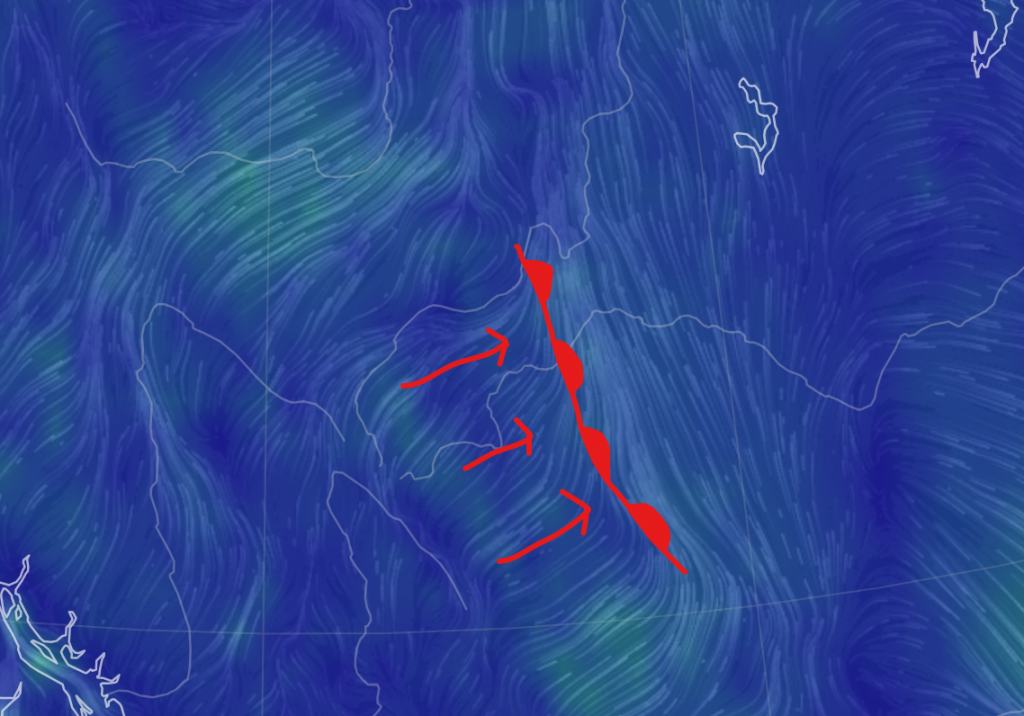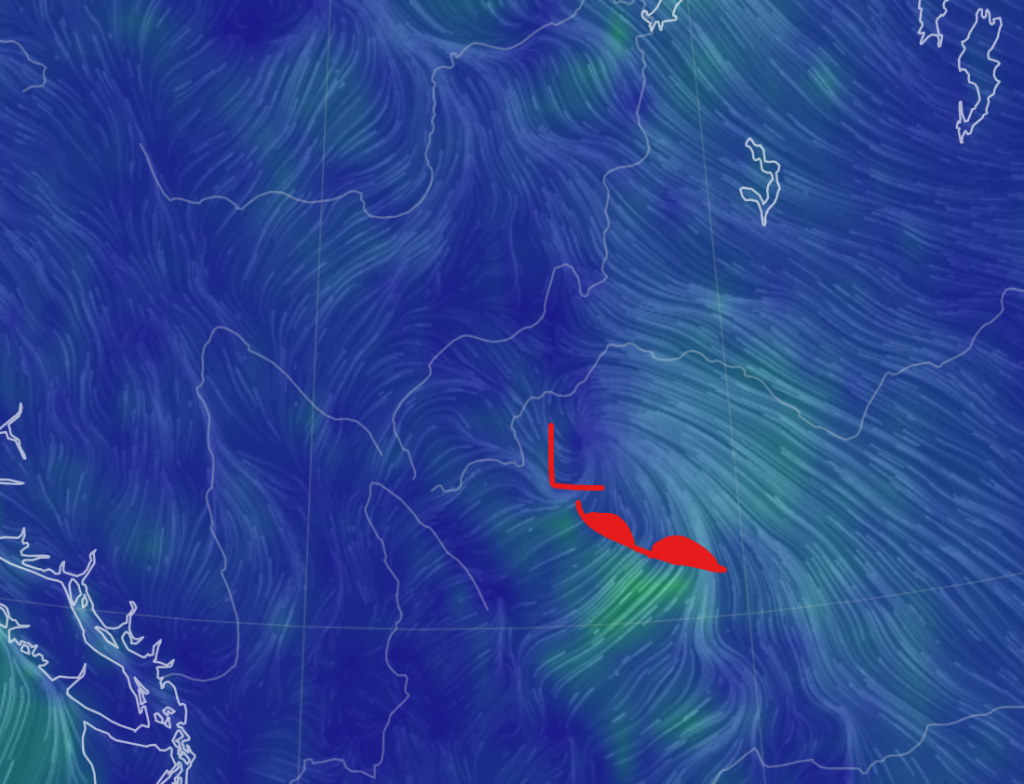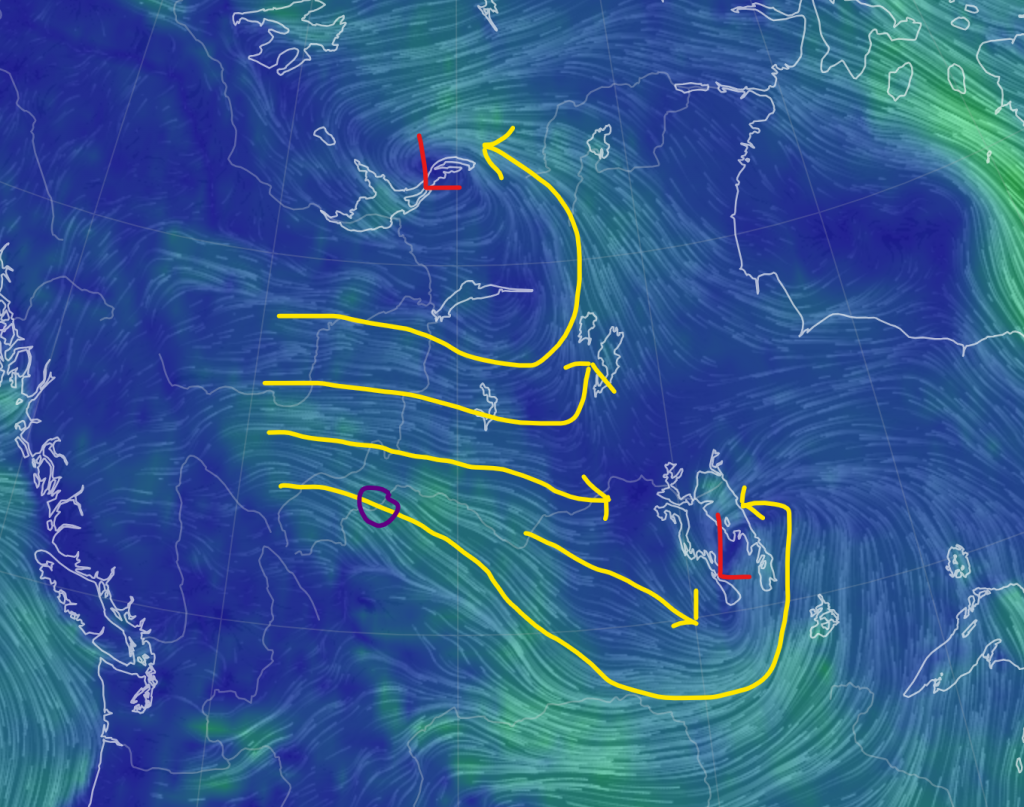
If you’re reading this on the day it is posted, take a look outside right now. You’ll probably see (and maybe hear) the strong gusts coming through the area right now. This is because of a series of low to the north and east of here, taking wind from the Rockies and carrying it through the area. Here’s a map to show you:
As you can see, we have two lows carrying strong winds straight through here (we are the purple circle). The forecasted peak winds are expected to be around 3 pm, with gusts possibly getting above 60 km/h.
Today will bring an average high, as will tomorrow. Tonight, the winds will calm, but not fully. Only tomorrow will gusts actually get below 30 km/h.
It does seem that there will be a chance of precipitation Sunday morning. It’s not set it stone yet, and the amount is far from certain. I would say we’re doing to get anywhere from nothing to 5 mm. As well, if the morning low is cool enough, we might get a flurry or two, but nothing accumulating.
That’s your Friday and weekend forecast! If I find time, another post will come later today.
All the way since the last part of August, we’ve been stuck in a hot, blocked pattern. Changes are happening now, and we are transitioning into a less volatile, cooler pattern.
Back on Saturday, we had a high of 1.8, about 4 degrees away from a record? When was the last time we were 4 degrees away from a record? In short, it’s been a while. Now I’m thinking that this was not a one-off, but a sign that we are finally exiting our hot, blocked-up pattern. Why? Siberia.
As I’ve mentioned a few times recently, there has been lots of snow in Siberia over the last few weeks. This creates a mass of cold air. South of Siberia, in the west Pacific, China, and Japan; all the way to the Philippines, it has been warm. This creates a strong temperature inversion, giving rise to a fast zonal jet stream. From the Pacific all the way to here, we have been very block-filled, but this fast jet stream has been slowly breaking them up. As well, the north Pacific has been cooling very fast recently, meaning the jet stream is going to want to be further south here.
What does that mean? Well, we are leaving the blocked pattern behind, and moving into a cooler pattern, with a more zonal jet stream. This means we will get short, weak heat waves with frequent weak-to-moderate cold waves.
Finally, to the forecast. We are warm today, average Friday through Sunday, then slightly cool to start the next work week, but maybe warmer near the end. There has been evidence of a cold wave coming for the last week of the month, but I’ll save that for a post next week if it persists.
Get ready, we have temperatures near record-breaking values, very strong winds, and even snow.
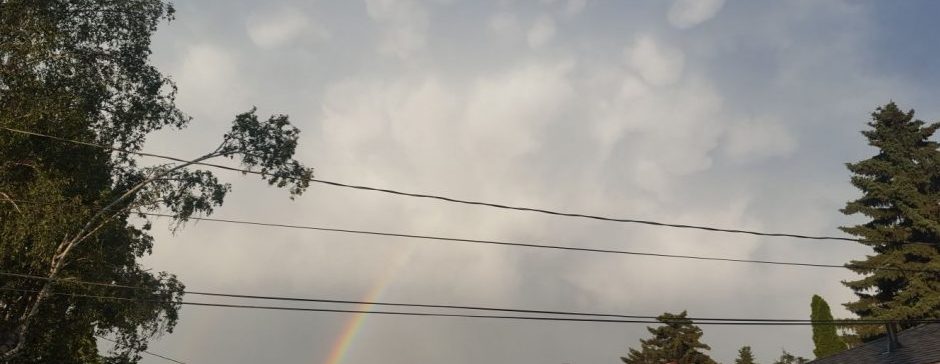
This morning, a cold front came through. This brought sustained winds of 32 km/h, gusting to 57. As well, there was some rain, which created the best rainbow I had even seen this morning, though that was likely a very local thing. We have a low currently in northwestern Saskatchewan, with a cold front trailing down to near here, and a bank of clouds northwest of that moving to the northeast. We had a small protrusion in the cloud that gave us the rain this morning. The low is quite deep, with its lowest pressure being 990 hPa!
Over the day today, we’ll be dry most of the time, with maybe to occasion short pulse of heavy rain, like we had this morning. Strong winds averaging 20 km/h, gusting to 50 will be present today coming from the northwest, as winds wrap around the backside of the low. Later today, the rain will head off northwest, and precipitation chances will drop from 60% to more like 20%. However, there is expected to be some snow in the Rockies starting tonight, which will spill out into the foothills, and possibly all the way to us. A very light, non-accumulating flurry could happen anytime overnight or tomorrow morning, but the most likely time is 6-8 am.
Now, back to temperatures. We were 15 degrees at 7 am, but now we’ve dropped down to 12. When will the temperature turn around so we can get a normal afternoon high? Answer: Never. The temperature, will keep dropping, and by sunset tonight we’ll be around 5. The temperature will keep going down through the night, and we will end up at a low around -2. The temperature will go up a small amount tomorrow afternoon, with a high around 1, but the temperature for tomorrow will stay within a degree of 0 for over half the day.
For winds, we will stay at 20 gusting to 50 for next 36 hours, while winds might shift to more straight northerly. Tomorrow night, winds will die down, and by Monday morning we will be calm, besides the remnant marginally strong gust. The mostly cloudy to overcast sky that will engulf the next 36 hours will as well start to break down tomorrow night continuing into the Monday, with a likely clear sky Monday night. Tomorrow night and Monday night the low will be around -5, and on Monday the high will be 1-3 degrees warmer than Sunday.
Okay, that all I have for you. Now you know what’s coming this weekend!
Here it is! Last year’s winter was quite a rollercoaster, with long periods of alternating warm and cold, as well as a lot of snow. So, what will it be this year? Currently, we’re far enough away that we can’t really be certain on anything. However, there seems to be an increasing amount of evidence of near to below normal temperatures, and near to above normal snowfall. Here, I’ll list out all of those signs.
Before we start, I would like to clarify what time range I mean by “winter.” Technically, it’s December 21 to March 19. That, however, does not really show the actual length of an Edmonton winter. Our typical first snow that doesn’t entirely melt until spring is in the first half of November. So we’ll put the start there, but for convenience round it to the beginning of November. For the end, we’ll say it occurs when the snow may still be on the ground, but the warming is noticeable and it’s starting to actually feel like spring. This would usually happen in the first half of March, and I’ll round it again to the start. So, our adjusted winter is November 1 to February 28.
So, let’s start with an easy one. La Niña. We are currently about 1 degree below average, with that value expected to drop even more. This isn’t a particularly strong La Niña, but not a very weak one. So, just with this, we can still expect a lot of both warm and cold, though cold will probably occur more often. Every La Niña is different, so we will have to look for other signs.
Next, the Pacific Ocean. Since spring, the sea surface temperatures in the northern Pacific, from the Gulf of Alaska to Japan, have been very very hot. This means the jet stream likes to be farther north, and that carries over to here. It’s partially the reason we were in one heat wave for most of September. During the last third of the month though, things started to finally cool down in the Gulf of Alaska. In the last week, very rapid cooling has begun in the entire area that was hot. This means the jet stream will want to stay lower, and heat waves will become much less likely, if this trend continues.
Another reason is what’s going on in Siberia. Lately there, it’s been cold, but more importantly snowy. Very snowy. A big mass of snow there is creating a mass of cold air, also pushing the jet stream south. This manufactures many a trough, meaning for the next month or two, big ridges will be very hard for the atmosphere to make.
Back to more global anomalies now. There is a condition that is stacked called Atmospheric Angular Momentum, or AAM. This has models that forecast it. For a while now, this has been far in the negatives, meaning the amount of west-to-east flow in the atmosphere has been very low. Models though, have been recently forecasting this to return to near normal, meaning fewer blocks will develop, and ones that do will be more easily broken up. For our geography, if there’s a block in the area, we’re very likely hot. If the AAM is positive, then few big heat or cold waves can occur, resulting in average temperatures. Out of all values, near neutral is the most likely one to have us end up will cold temperatures.
Finally, some more long-range models. Recently, we’ve gotten close enough that different ones are starting to agree a lot, and they’ve been saying what I said at the start of this post. Near to below normal temperatures, and near to above normal snowfall. This hasn’t just been for part of the winter time frame, but the whole thing.
One more thing to mention; conditions right now are actually surprisingly similar to last year, so last winter might not be too bad of an analog of this one.
So there you go, the preliminary 2025-26 winter forecast. It’s more like the winter forecast, because the non-preliminary forecast will probably just end up being the monthly outlooks.
Over the last 3 days, temperatures have ended up about 1-2 degrees below normal. Then all of sudden, we’re really hot today! As well, tomorrow will possible be cooler than the weekend, and we might reach back to the 20s again on Friday!
If you read the previous post, you would probably know why we’re so hot today. We had a trough that came through and cooled thing down, but now a weak ridge has come. As well, we will have an approaching trough behind this ridge break off and become a cut-off low off the coast of the northwest US. That low is not entirely escaping though, because part of it will split off and track over northern Alberta. This other low, currently in northeastern BC, is partly the reason we’re so hot. It’s bringing up warm air from the south with its counter-clockwise winds. This low will generate a cold front, expected to pass through sometime tonight. It might bring a shower or two, but most, if not all, of the precipitation will be to the north and west of here.
Because of that front, we’ll be much cooler tomorrow, with a high of 10-12. The low Wednesday night looks likely for frost. However, after the low cuts off, we’ll end up back in warmth. We’ll start with a high near-to-slightly-above normal on Thursday, then maybe back all the way to 20 again on Friday.
After Friday, there will be a strong cold wave, but if you want to know more about that, check out the previous post.
A lot is coming in the next week, in weather, but also this blog. Get ready for an August and September recap, preliminary 2025-26 winter forecast, and 2025 wildfire season recap, as well as the normal one medium-range forecast (this one) and 2 short range. This one is about a very strong cold wave on the way this weekend, which may or may not end up continuing for a while.
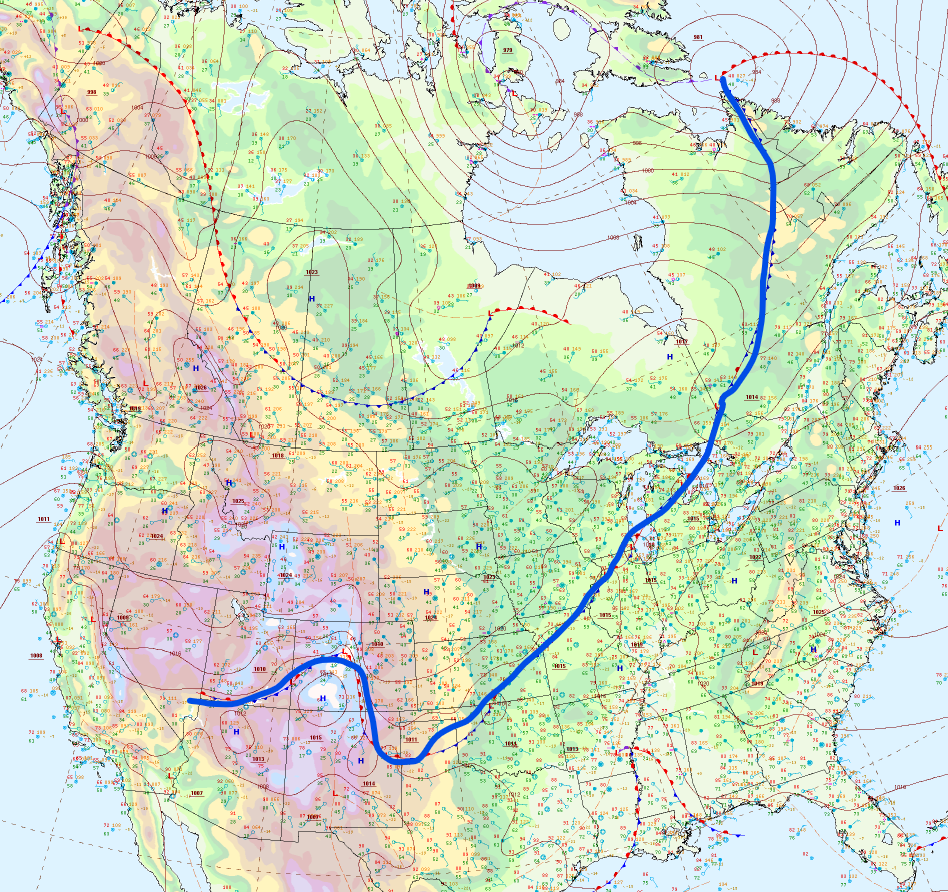
Let’s start with right now. Here is a surface analysis map.
That blue line is a cold front, actually the same one that came through over 50 hours ago on Saturday morning. You can see on the map it is connected to a low around the northern tip of Labrador, and there is also another low a little to the west of it. That is a trough.
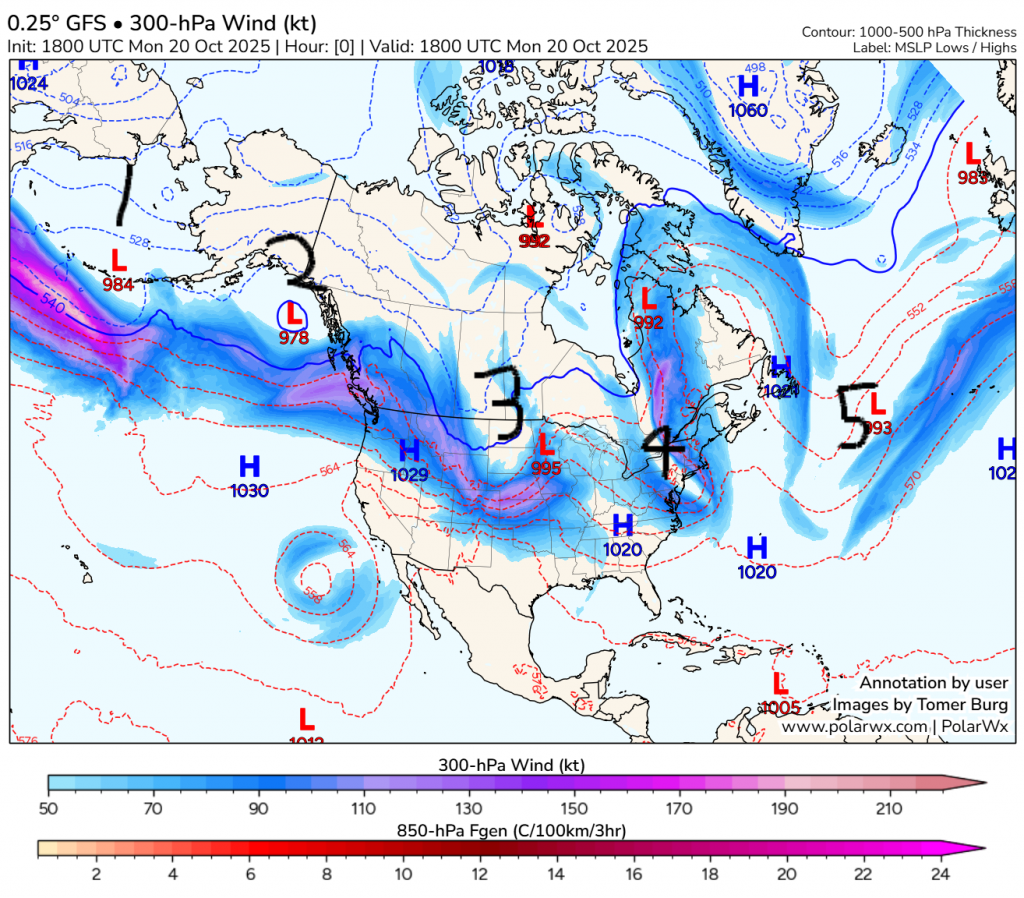
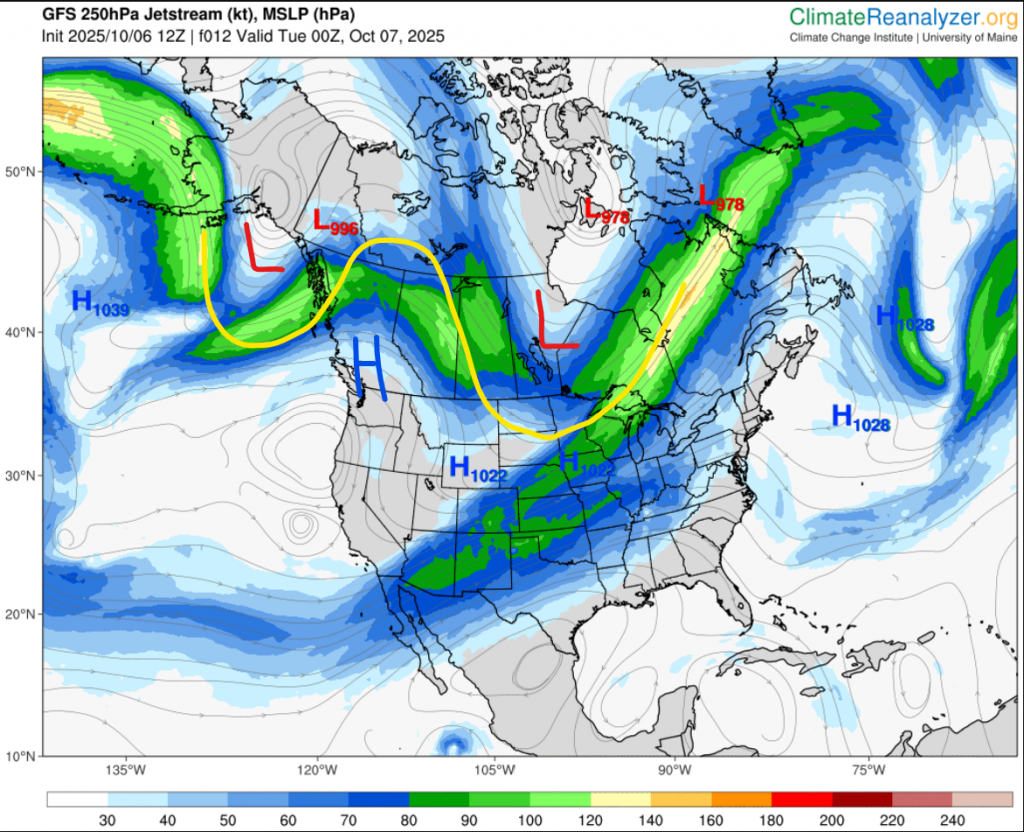
Now, let’s go to the forecasted current conditions from the GFS model run this morning.
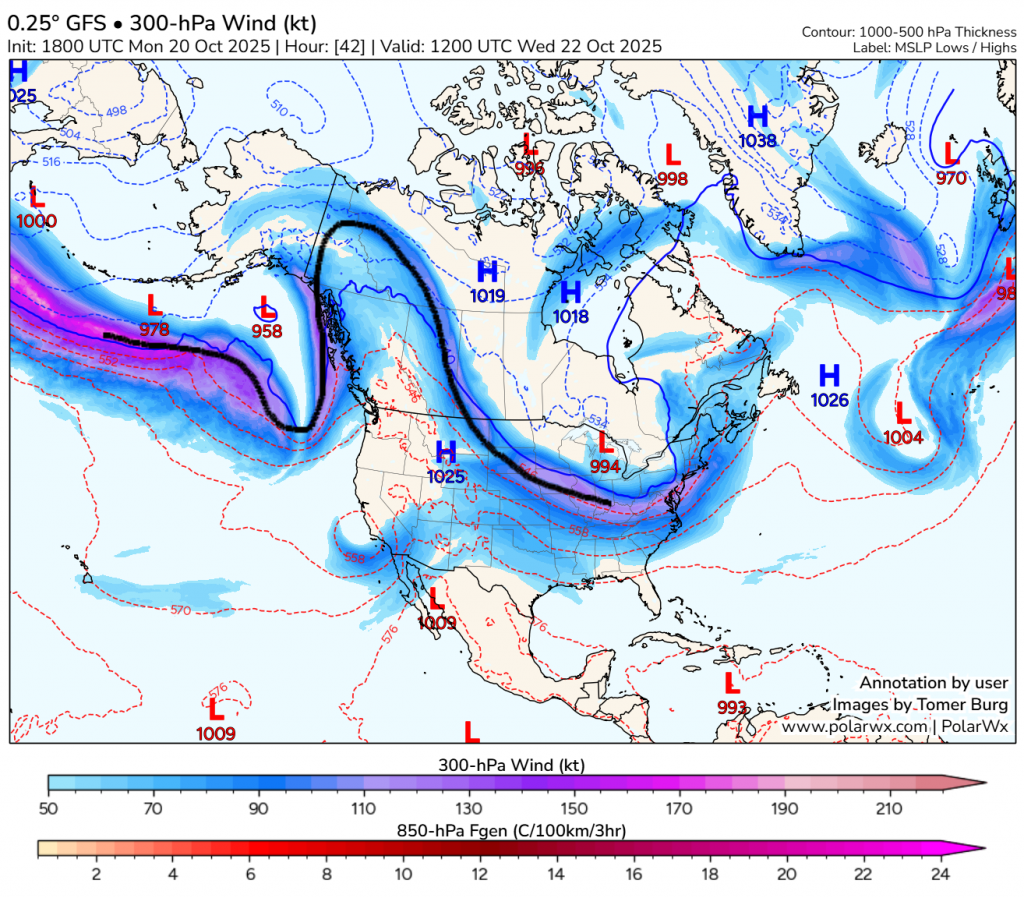
You can see the same two lows, and the big trough in the jet stream. I also marked a high and two lows that make up on omega block we have right now. This isn’t a strong one, and it’s also moving. As you can see, we’re exiting a trough, (which was the one that brought -3 on Saturday night) and we’re entering a weak ridge.
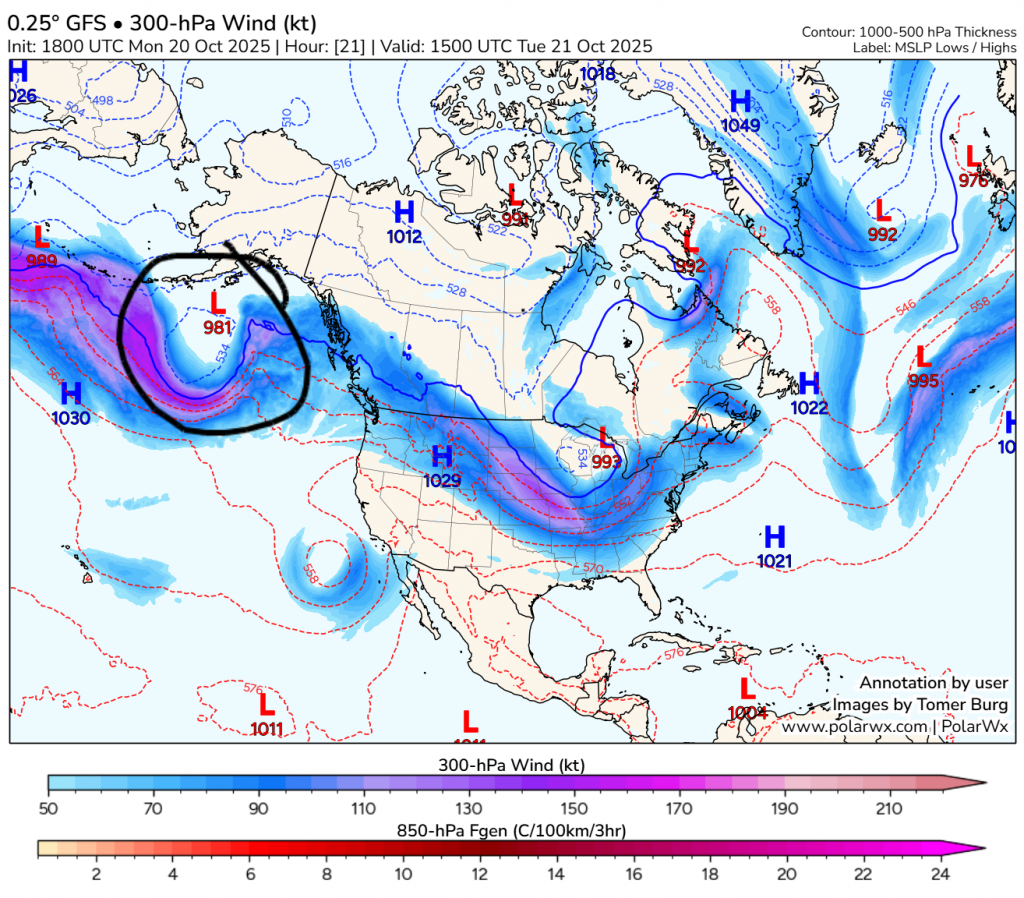
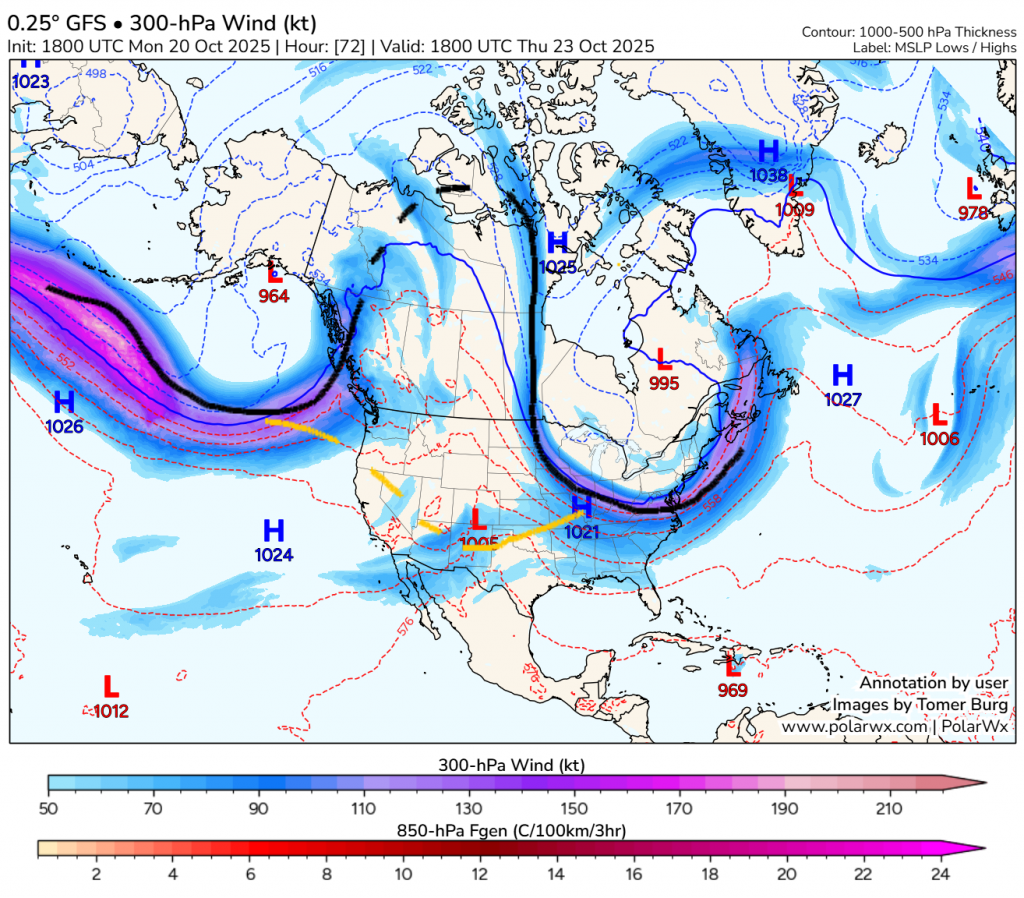
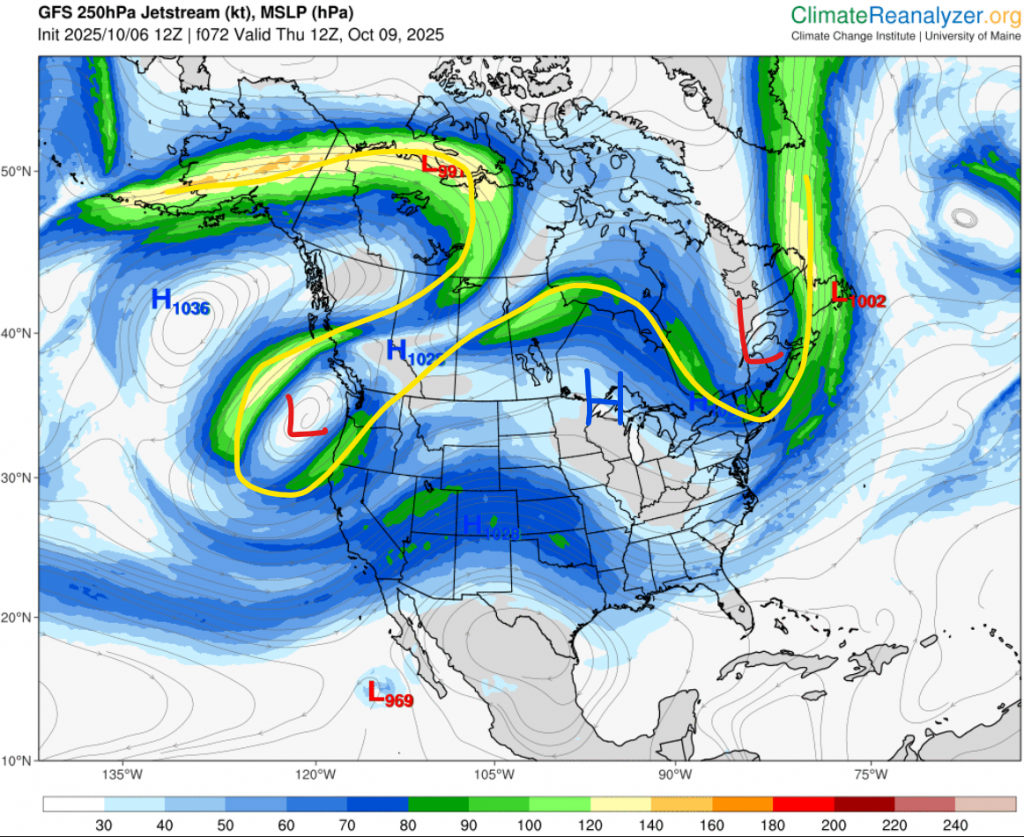
Now, I’ll jump ahead all the way to Wednesday night.
I marked the same highs and lows as before, so you can what’s changed. As you can see, the omega block moved east, but the west low is breaking off. This is not a rare occurrence, but actually the normal. When an omega block travels from west to east over North America, the westerly low will almost always break off. For us this week, it means we’ll get a short shot of slightly below average temperatures on Wednesday, before we warm back up again as the low completely cuts off.
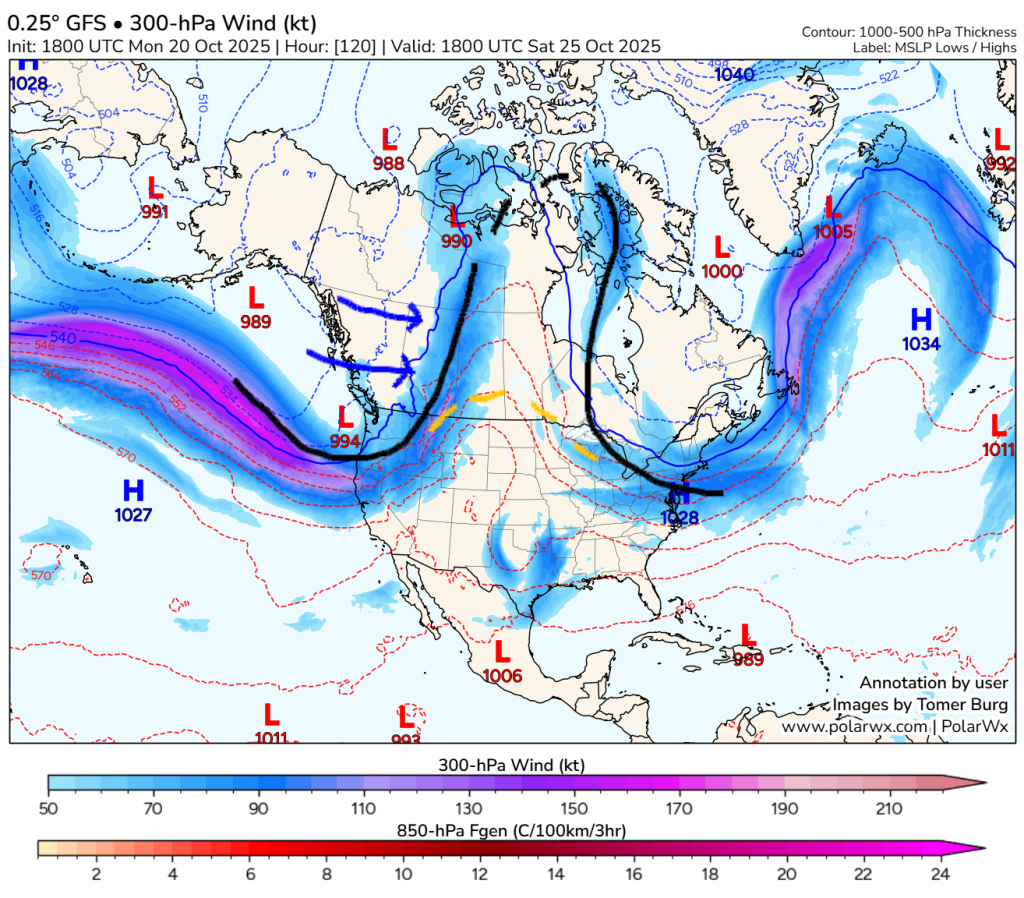
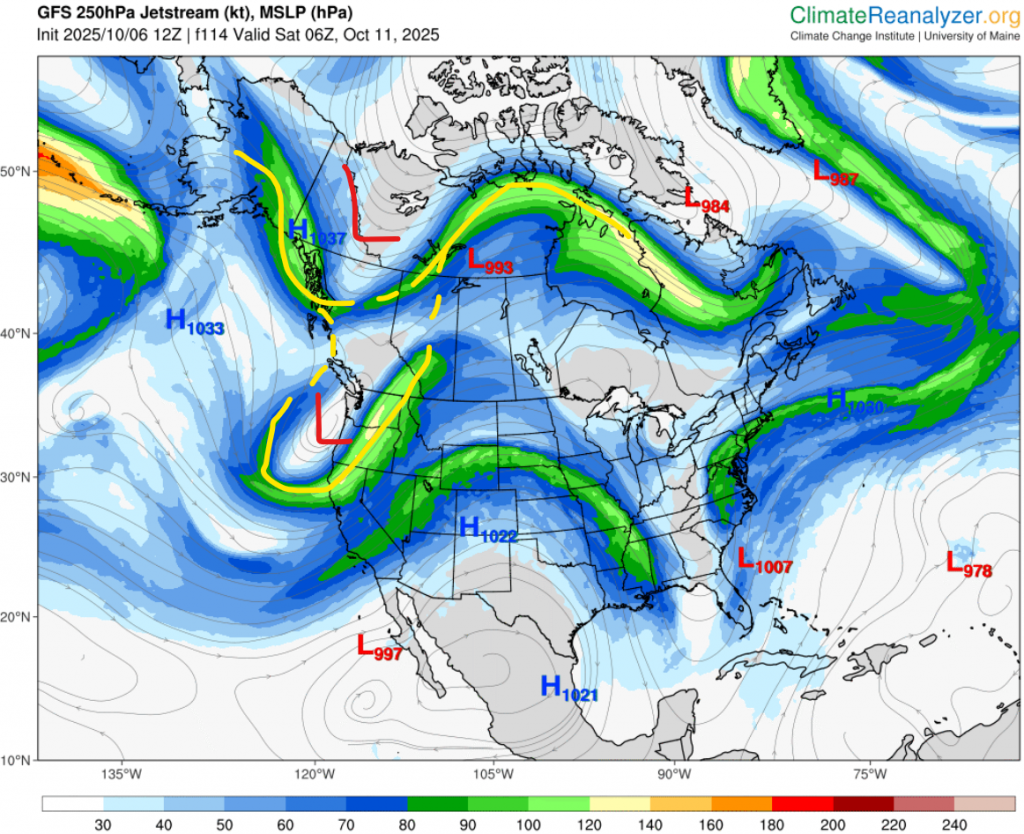
It is not until Friday night, when something very interesting happens. Here’s the map:
As we can see, a new trough has come over from Asia, and is starting to interact with the cut-off low. Once they get close enough, the low reconnects, and a very deep trough is created, which will drop temperature from near 20 to negatives in only 36 hours.
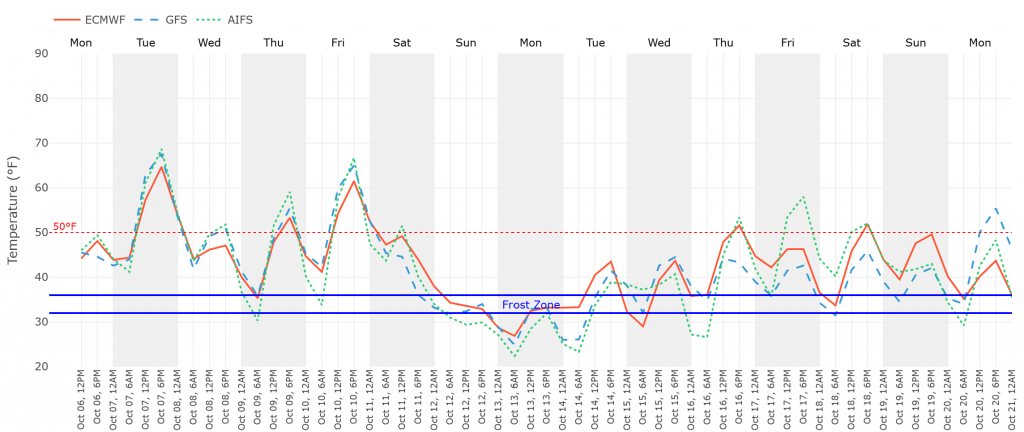
So here we go, the forecast for the cold wave. Let’s start with Environment Canada. Currently it’s saying a high of 16 on Friday, low of 3 Friday night, 7 Saturday, -2 Saturday night, and 4 Sunday. Accuweather, starting on Friday’s high is 21, 4, 10, -2, 2, -5, 6, -3, 9. Finally, The Weather Network says 17, 8, 10, 1, 3, -2, 6, -1, 7. So overall, the website forecasts are agreeing the coldest day will be Sunday, with a high of 2-4. Now for the models.
Still waiting on the update so this can be in Celsius. Overall here, we’re agreeing on more near 0 highs for both Sunday and Monday.
Now what about precipitation? There might be some, but probably not a lot. It seems a front will probably give up a bit, but the main low will pass south of here. The timing currently is “probably just Saturday.” If we get any precipitation in the night, then we might just get our first snow!
The title did say “MAYBE extended,” so what’s that about? Most forecasts are thinking after Monday, we’re going to return to near-to-above normal temperatures. However, there is one interesting outlier: GFS. If you look back up to the graph above, You’ll see it. The average high for that time is around the red line, but you can see GFS in blue is well below that. So what is going on? Well, I dug into it, and it’s really complicated.
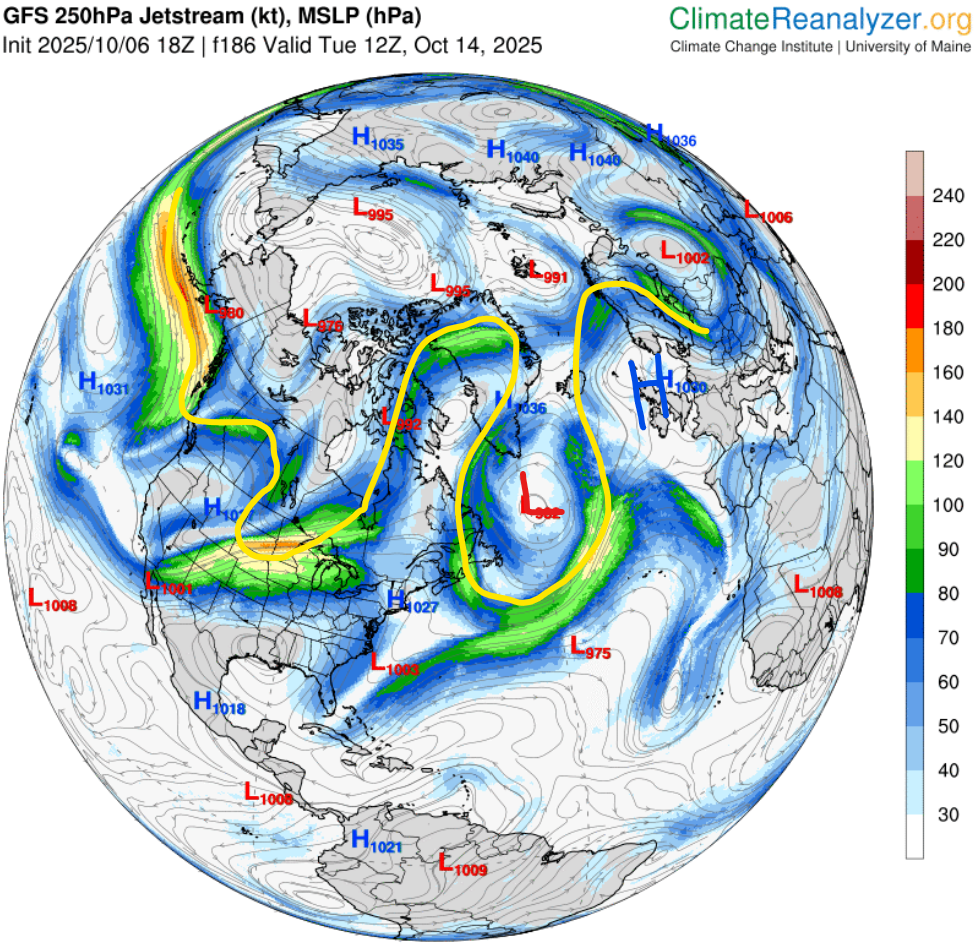
It seems the thing this model is forecasting is really big blocking high appearing over Europe. If the model is right, this will block the trough we’re just exiting now from moving east after it travels in the Atlantic. That is the low you can see in the picture. Because of this immense block, the jet stream erupts into chaos in eastern Canada, and our trough coming this weekend doesn’t really have anywhere to go, so it kind of just stays here.
This is only one model, and no other have caught onto it yet. Maybe it’ll disappear in a day or two, or maybe an extended cold wave will manifest. We’ll just have to see.
Hey there! Sorry posts have been quite few and far between this last month. The whole transition back to school, then not really having much time to post things, as well as getting sick have all contributed. I am going to do better this month though, hopefully keeping up 1-3 posts a week. (Also, there’s the strike. I’ll have lots of time for posts during it!)
So, let’s get started. Things are okay for confidence for the next week, then it drops off to basically unpredictable after the 10th. I’ll explain why later. First, this week!
As you have seen if you’re checking your inbox (or your junk file for my grandma for some reason) lately, the next few days are slightly above average, then down to slightly below on the weekend. For the most part dry, maybe a shower here or there. Since it is October, we do have to talk about frost. Our first frost was actually technically last Thursday morning. I woke up to the lightest coating on the rooftops, but not even anything on the ground. For our first significant frost, we’re still waiting. There is a chance these next for nights, maybe ~20% each, but nothing saying a definite frost until Saturday night. So our first significant frost is probably at the latest Monday morning. I say that because we might actually end up pretty windy for Saturday night, which could significantly reduce the amount of frost that forms.
Okay, now were getting past 5 days. At this point, the only things safe for me to say is temperature. Nothing else can really be certain. First, we have a heat wave. It’ll probably be short, only spanning one or two days around Tuesday and Wednesday next week. Second, a possible cold wave. It’s been showing up for a while now on The Weather Network, as well as the GFS and ECMWF weather models. Accuweather started to pick it up yesterday, though AIFS (An AI model run by the same company as ECMWF) has yet to show it. Currently it is not saying a different signal, just no signal. I’m not sure how long this cold wave will be, but there’s evidence of it spanning past 2-3 days.
Now third, we have…nothing. Yes, nothing. October is a very wildcard-y month, and especially this year. There is basically no signal anywhere for anything, and as we’ve learned for months now, sub-seasonal models (2-8 week forecasts) can be trusted is no way possible. As well, a rapidly strengthening La Niña, active west Pacific (tropical systems form there like to mess up the jet stream, especially at this time of year) as well as lots of snow in Siberia (which usually this early causes a lot of cold air to come from there and head east and once again mess up the jet stream) is creating massive quantities of uncertainty. This paired with October being a very transitional month, and there isn’t really anything I can actually predict. Nothing, beside that it’ll probably be volatile, because October always is.
So for now, that’s where we’ll have to leave it. Maybe I’ll do some sort of mid-October update, or just try to keep up the weekly medium-range forecasts.
The omega block continues to dominate, and we will see even more hot, but not record hot heat for the rest of the week.
Yesterday the high was 24, and today it seems we have 25. Quite hot, knowing the average high for this time of year is 18. It seems we’ll have similar temperatures for Thursday and Friday, but tomorrow and Saturday are going to reach up into the high 20s.
Right now, it’s looking like tomorrow’s high will be something like 28 or 29, a full 10 degrees above normal. For Saturday, maybe something similar. If you’re wondering if we may break a record, then I’d say probably not, but it could happen on Saturday. The record temperature for tomorrow is 33.6, from 1981. On Saturday, it is 29.4 from 1922.
What about the lows? The forecasts for these have been very unreliable, so we’ll probably see a lot of variation. There might be some that are 12 or 13, and others that get to what they were this morning (5.7). For the next 5 nights though, they will for the most part probably end up in the 9-12 degree range.
That’s it! Just a small update on the heat. If you’re wondering what is coming after this and how that pattern seems likely to break soon, check out the post that came out yesterday.
Sorry it’s been a while since the last post on the blog; I was taking a break for the first bit of school. Somehow this heat wave is still going, but there seems to be evidence of it possibly ending soon.
Over the next 6 days, temperatures are going to continue to be quite above normal, with the hottest being Wednesday and Saturday. This heat is because the omega block, which was moving east, but kind of stopped a handful of days ago. Despite such a strong ridge, there actually is a low under it that is giving mainly Saskatchewan and Manitoba quite a few showers right now. This low will likely only give us a shower or two later this week, if anything.
The main thing to talk about here is next week. It seems the temperatures will cool a bit again, with a lot of uncertainty for where they’ll land. For Saturday and Monday, I think something like highs in the low 20s. We might see a bit more heat on Tuesday or Wednesday (It’s appeared on AccuWeather, which recently has usually been the first to find short one-day heat events). It is after this, that we might finally get a cold wave.
Even though this is a very recent thing (It has only really appeared in the last 24 hours), all the models are agreeing a lot about a cold wave late next week into the last weekend of September. It’s on The Weather Network, it’s on Accuweather, it’s on the US weather model, it’s on the European model, it’s even on the AI model. Everywhere temperature forecasts are dropping. I’m still not completely set on this though, because we’re talking a while out.
Currently, what are the models actually saying the reason for this long-awaiting cooldown is? I’ve looked, and it seems to be one thing: The Pacific High. for quite a while the Pacific high has been far out west. Usually it’s only 1-2 thousand kilometres off the west coast of the US, but for a while now it’s been more 3-4. It seems later this week it may actually drift back to its normal position, which when paired with the low in the Gulf of Alaska will really speed up the jet stream, pushing out the block. The low then sends out a trough, and down the temperature goes.
Well, that’s it for now! I will definitely provide more updates later, when confidence is more greatly acquired.
The July heat was back on today with a near 30 high, but tomorrow, we might actually end up below average.
Today was brought a high about a degree and a half away from 30, but it’s actually ended up pretty windy. That combined with the haze means it feels significantly cooler then the actual temperature. These northerly winds will continue tonight and into tomorrow morning, where they will begin to bring much cooler air. Tonight’s low will be a few degrees above normal, but then tomorrow the temperature will probably stay under 20 the whole day. The average high for September 4 is 20.3, meaning this will likely be the first below average high since August 21!
In terms of smoke, it’ll stay pretty bad (AQI well above 100 paired with an air quality warning) for tonight, but tomorrow it seems the winds might bring clearer air. It won’t be completely smokeless, but Thursday afternoon into the weekend will be very clear.
Looking ahead, I would say into the weekend we’ll warm back up to at a maximum a little below what it was today, and smoke will probably stay out of the area until at least Sunday or Monday.