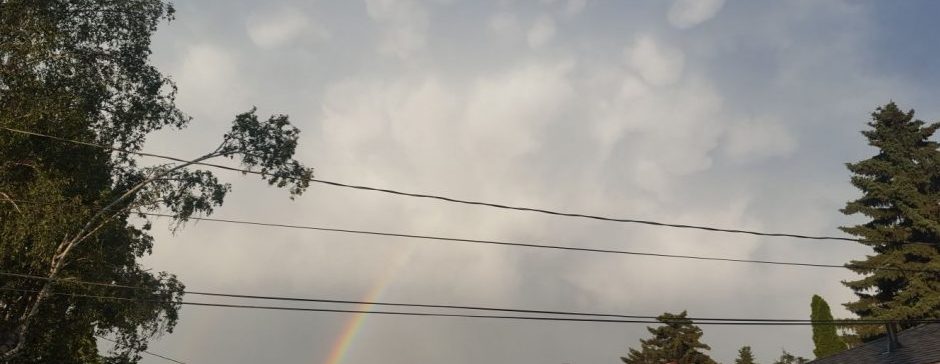
Today, it’s looking like a high a of 34. Or maybe 33. We’ll see. It might feel cooler than yesterday though, because there’s a lot more of a wind. The main discussion in this post though is about what is coming after the heat, which currently is not the most agreed thing.
It looks like our last 30 degree day of the heat wave is going to be Saturday or Sunday. After that, it look like a cooling trend for about two days back to near to slightly above normal. Beyond early next week though, we currently don’t really know what to expect. Here’s why:
A lot of times this summer I’ve mentioned the Pacific high. This is a high that is always in the north Pacific. It never really leaves. There is another one for us to worry about though; and that is the Bermuda high. This one is positioned over the Atlantic Ocean pretty much always between 15 and 60 degrees north. Even though weather systems propagate from west to east, this high does actually affect us a bit, and is one of the more minor reasons we are as hot as we are right now. The Bermuda high for most of the summer has been centred over the western Atlantic. However, about 5 days ago it actually moved significantly for the first time this whole summer break; over to the eastern Atlantic. The main role of this high is basically a roadblock for North American troughs: Whenever a low encounters it, it either stays in place or deteriorates. The high moving to the east opens up more opportunities for troughs to hit eastern Canada and the eastern US.
You’ve probably heard of the many frost advisories in eastern Canada and even parts of the US recently. This is because a big upper-level low has planted itself over there. Because the Pacific and western Canada is all “blocked up” (as I have mentioned in past posts), the lows have nowhere to go but east of here. If the Bermuda high hadn’t moved, a low might have been able to move the block more east, and we could be the one with a frost advisory right now.
So, can we get to the forecast? The high in the rex blocked Pacific is expected to actually move west this weekend (meaning the eastern cold wave will end then), before another high replaces it in the rex block. It does seem following the move of that high, a low above it is going to make a massive shortwave trough down to here, meaning for a very brief period of time, we might end up having below normal temperatures. Early next week, the shortwave trough will grow to a longwave trough, but by then it will be out of the area. This means we will end up sandwiched between systems, and the jet stream will be overhead nearly north-south for 3 or 4 days. We might still end up a little below it, so we’ll probably end up above normal, but far below what we have right now.
After this though, we get to the area of uncertainty. A lot of forecasts past 7-10 days in the last month have been very unreliable, for some reason. What they normally do is they pick up on a pattern and then it comes. But this last month of those forecasts just haven’t found the patterns that we end up getting. For example, this heat wave didn’t show up until only about a week before it! For something this prominent, the usual would be something like 12-20 days before.
There is evidence of the rex block completely breaking down near the end of next week, though that’s not been in every model or every model run. The most likely thing right now is maybe just toughing 30 again near Friday (or something around there) next week, then maybe a cold wave. Could be short, could be longer. The low that could do this is coming enough from the north that it will be on the drier side and might start raising questions about an early frost. Another possibility is an omega block ends up over BC. It’s not the most likely thing, but it could happen. This would probably have us end up in the 25-30 degrees range for highs for a least a handful of days. Anything mentioned in this paragraph is not certain. Right now, don’t trust anything that seems confident past 10 days.
There is one more thing I want to talk about here today. It is more of long-range kind of thing, but also not really. As we head into fall, we will start to see more of our cold wave some from lows farther north. This means they will be drier, but also cooler. As well, at some point soon, we’re going to have to start looking at a transition of lows being cold and highs being warm to highs being cold and lows being warm. This is still far off, but we might start to see some signs of it in the near future. Fall is the most unpredictable season of the year, and we’ll have to see what happens over the next two months, as well as monitor when and how fast the leaves fall. The main thing the trees look for for when to start shedding leaves is the amount of light, but they also take in to account the temperature, humidity, dew point, and much more. If you remember last year, it was pretty late, with most of the leaves falling in late September and into early October.
Anyways, that’s it for now. The next medium-range forecast will be September outlook coming on Sunday or Monday, depending on how much time I have. Keep your eyes peeled for a short long-range update later this week, and a short-range early next week talking about a hopefully more certain version of the same thing that was discussed here.